

IT Infrastructure Services

Server Management | IT Infrastructure Services

We take over regular maintenance, monitoring and capacity management of your physical and virtual servers.

Server Management – image 1
Server Management – image 2

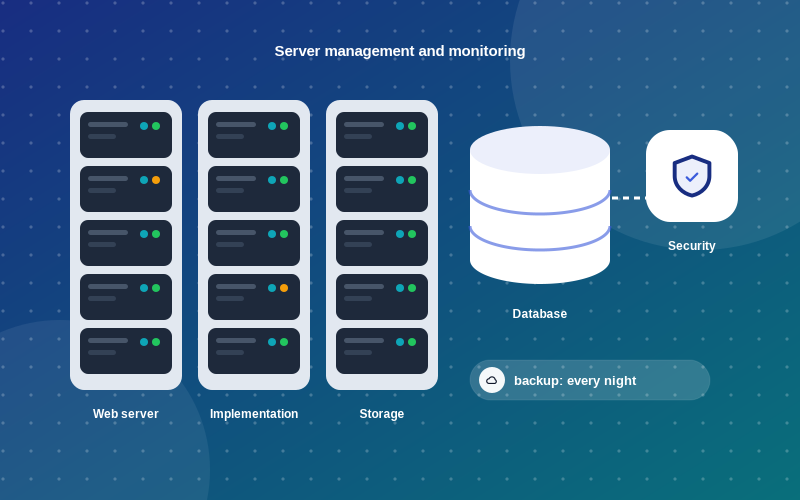
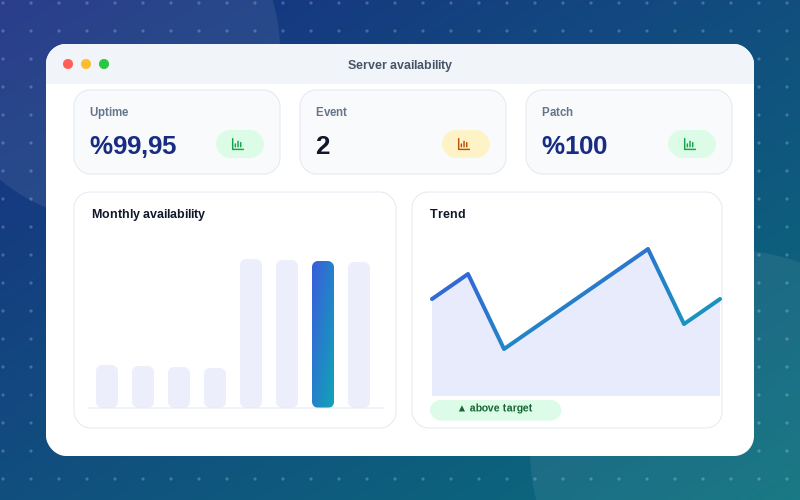
We take on routine maintenance, monitoring, capacity planning and incident response for your physical and virtual servers. Deliverables include an up-to-date server inventory, a monitoring and alerting structure, capacity reports and a defined incident process.

Inventory, standards and regular maintenance

The first step of management is a current inventory showing which server runs where, for what purpose and with which operating system and hardware version. On that basis a maintenance calendar is drawn up: operating system updates, firmware, disk health, backup verification and certificate or licence dates. With responsibilities defined, no maintenance task is left without an owner.

Capacity planning and virtualisation

CPU, memory, disk space and network usage are monitored over time, and growth trends are projected for the relevant periods. In virtual environments, overcommitment, noisy-neighbour effects and resource imbalances are examined. That way, when new hardware or cloud capacity is needed, you can present it as a request based on measurement rather than guesswork, one that can be budgeted and whose timing is known in advance.

Incident response and protecting continuity

When a server stops responding, the first job is to limit the impact and restore service; the root cause is sought afterwards. Incidents are classified by severity and recorded, and who steps in within what time is defined in advance. After every serious incident a short review is written, and corrective steps to prevent a recurrence are added to the configuration or to the monitoring rules.

What is included?

  • Server inventory: Role, owner, operating system, licence and warranty details of physical, virtual and cloud servers are kept in a single record.
  • Routine maintenance: Operating system patches, firmware updates, disk health checks and scheduled restarts are tied to a calendar.
  • Monitoring and thresholds: Thresholds are set for availability, resource use and service status, and responsible people are alerted when they are exceeded.
  • Capacity report: Resource usage trends and growth projections are presented as justification for planned investment or cloud costs.
  • Incident management: Severity levels, escalation order, communication chain and the format of the post-incident review are defined as a written process.

How we work

  1. Discovery

    An inventory is compiled for all servers; the operating system, hardware, critical services, dependencies and the current monitoring and backup status are documented to prepare an initial health assessment.

  2. Planning

    Based on the initial assessment, a maintenance calendar, monitoring thresholds and an incident process are designed, and how critical each server is gets classified together with business units.

  3. Implementation

    The monitoring and alerting infrastructure is put into service, maintenance tasks are applied in the first cycle on a pilot group of servers, and after results are verified they are rolled out to the other servers.

  4. Support

    The service continues with monthly reports, capacity reviews and post-incident reviews; the inventory and documentation are updated with every change, and improvement proposals are discussed in periodic meetings.

What you gain

Your server infrastructure becomes visible, and which system is where, who is responsible for it and what state it is in can be followed from a single up-to-date record.

Problems are caught through alerts before users notice them, unplanned outages decrease, and when an incident occurs, the order of response and the responsibilities are clear.

Capacity decisions are based on measurement, and investments such as hardware renewal, cloud migration or licence expansion are planned in good time and with justification.

Who is it for?

This service suits organisations with a few to dozens of servers on-premises or in a data centre but without enough staff to monitor and maintain them. Those who see maintenance depending on individuals, IT managers who need capacity data before hardware renewal or a move to the cloud, and teams unsure who does what during an incident will benefit.

Frequently Asked Questions

Some of our servers are on-premises and some in the cloud; can you manage both together?

Yes. In hybrid environments, servers are gathered under the same inventory, monitoring and maintenance calendar; only access and network details differ. We clarify the cloud provider's responsibility boundary at the start and bring the operating system, application and security layers that belong to you into the service scope.

Do you respond to incidents around the clock?

The scope and hours of response are clearly defined in the contract. Support during business hours is standard; options such as out-of-hours on-call cover for critical systems can be agreed separately. Without overpromising, we set down in writing which severity level gets a response within what time, and we report against it.

Related services and resources

Quote & demo

Let's evaluate your project together.

Let's start with a short call about QISO demo, ISO consulting, Artificial intelligence feasibility or your custom software needs.

  • QISO demo
  • ISO consulting
  • Artificial intelligence
  • Custom Software