

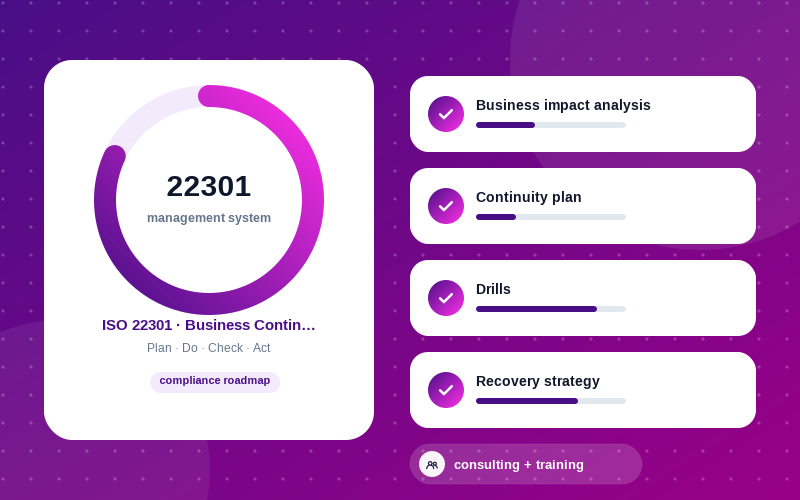
ISO 22301:2019

ISO 22301 consulting

Security and resilience — Business continuity management systems — Requirements

ISO 22301 consulting

What is ISO 22301?

The standard that sets out the requirements of a business continuity management system for sustaining and recovering critical activities during a disruption.

Purpose and scope

To reduce the impact of disruptions and ensure critical activities resume within the target time.

Who is it suitable for?

Finance, energy, healthcare and technology organizations that provide disruption-sensitive services.

Required processes

  • Business impact analysis
  • Risk assessment
  • Business continuity strategies and plans
  • Exercises and tests

Implementation stages

  1. Initial meeting and scope definition
  2. Current state (gap) analysis
  3. Implementation plan and role assignment
  4. Developing policies, processes and documents
  5. Implementation and employee training
  6. Internal audit and management review
  7. Support in preparing for the certification body's audit

Scope of consulting

  • Current state and gap analysis
  • System design and document preparation support
  • Employee awareness and implementation training
  • Internal audit support and corrective action tracking
  • Preparation for the certification audit (the certification decision does not rest with BDHA)

Training and implementation support

Awareness, implementation and internal auditor training for ISO 22301, together with implementation support throughout the process, is provided. Training and is not a consulting, certification or accreditation activity.

ISO 22301 consulting establishes a business continuity management system: business impact analysis, continuity strategies, business continuity plans and an exercise programme help keep critical activities running during a disruption.

Business impact analysis and critical activities

The foundation of continuity work is the business impact analysis. For each product and service, the effect of an outage over time, the maximum tolerable period of disruption and the recovery time objective are determined, and the people, premises, technology, data and supplier resources the activities depend on are identified. The result is a reasoned priority order showing which activity must be restored first.

Strategies, plans and exercises

Based on the analysis, continuity strategies such as alternate work locations, remote working, backup suppliers, data backup and manual workarounds are evaluated. The chosen strategies are turned into an incident response structure, a communication chain and activity-level business continuity plans. Plans are validated through tabletop scenario sessions and functional exercises, and lessons learned are fed back into them.

Certification and the limits of our role

BDHA does not issue certificates; certification is carried out by authorized, accredited certification bodies. BDHA provides consulting and preparation: system documentation, exercise records, internal audit and management review fall within this scope. Conformity of your arrangements with the standard is demonstrated during preparation through consistent records.

What is included?

  • Context and scope: Boundaries for continuity are set based on the organization's products and services, locations, legal obligations and stakeholder expectations.
  • Business impact analysis and risk assessment: Critical activities, disruption tolerances, dependencies and disruption scenarios are recorded.
  • Continuity strategies and solutions: Alternate sites, remote access, spare equipment and supplier alternatives are evaluated against cost and impact.
  • Business continuity and incident response plans: Crisis team duties, notification chains, decision authorities and recovery steps are written per activity.
  • Exercises, testing and improvement: Plans are tested with scenarios, results are evaluated and used as input to the management review.

How we work

  1. Discovery

    The organization's products and services, current emergency and backup practices, legal requirements and past disruptions are reviewed; scope, continuity policy and project team are defined.

  2. Planning

    The business impact analysis is completed in workshops with unit managers; critical activities, recovery objectives and dependencies are mapped, and disruption risks are assessed.

  3. Implementation

    Continuity strategies are selected and business continuity and incident response plans are written; roles are assigned, contact lists updated and relevant staff trained on their roles.

  4. Support

    Tabletop and functional exercises are held, the internal audit and management review are completed, and records and open gaps are checked together before the certification audit.

What you gain

Critical activities, acceptable outage periods and dependencies are documented, giving everyone a common reference for decisions during a disruption.

Teams know who does what in a crisis, and plans proven through exercises make the response more orderly and quicker.

You can show customers, regulators and tender stakeholders with records that you are prepared for disruptions, and you gain a system ready for the certification process.

Who is it for?

Suited to organizations where an interruption has serious customer, safety or financial consequences: manufacturing sites, logistics and distribution firms, banking and insurance, healthcare providers, telecom and cloud providers, energy companies and public bodies. It is designed for management teams that want a workable crisis management discipline rather than a plan that sits on a shelf.

Frequently Asked Questions

Is ISO 22301 the same as a disaster recovery plan?

No. Disaster recovery usually focuses on restoring IT systems. ISO 22301 is a management system approach that addresses people, premises, suppliers, data and technology together. IT recovery plans become one part of this system and are linked to the objectives set by the business impact analysis.

How often should exercises be held?

The standard does not set a fixed frequency; it expects exercises at planned intervals and after significant changes. In practice, at least one exercise a year covering critical activities is planned. The objective, scenario, participants and resulting actions are recorded so that they can be presented as evidence during the audit.

Related services and resources

The edition and validity status must be verified against the official ISO/IEC catalogue and the national standards body before publication.

Quote & demo

Let's evaluate your project together.

Let's start with a short call about QISO demo, ISO consulting, Artificial intelligence feasibility or your custom software needs.

  • QISO demo
  • ISO consulting
  • Artificial intelligence
  • Custom Software