

Artificial Intelligence & Intelligent Business Processes

Enterprise AI Applications | Artificial Intelligence & Intelligent Business Processes

We develop AI applications that work with your organization's data and respect access permissions.

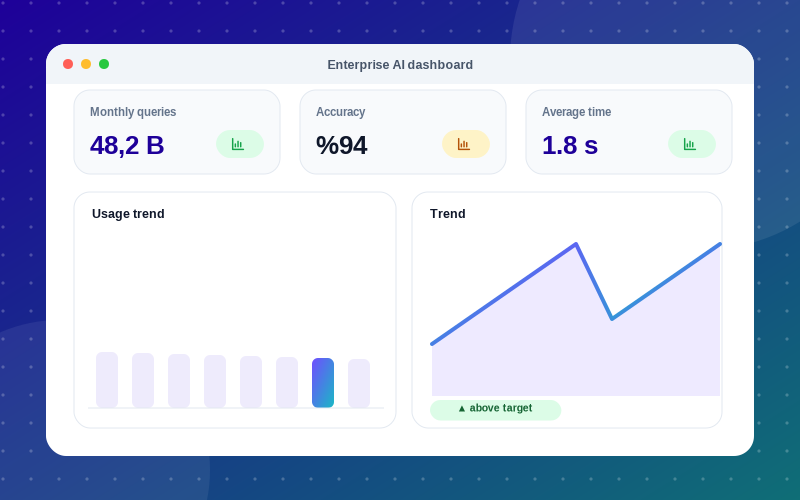
Enterprise AI Applications – image 1
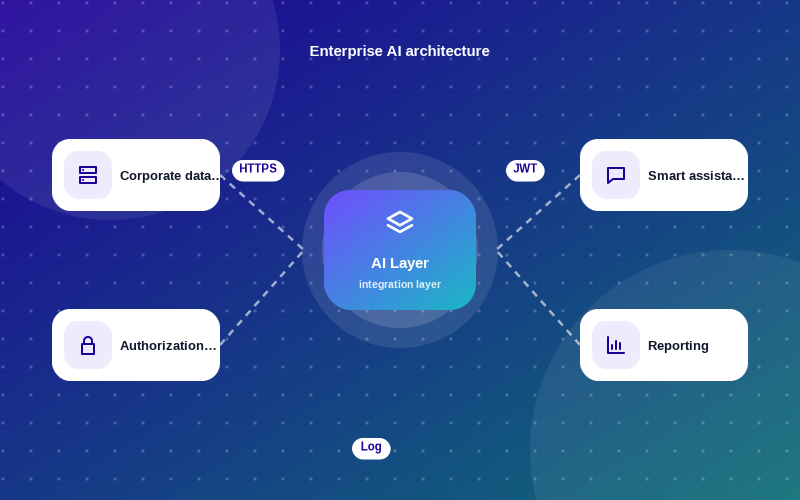
Enterprise AI Applications – image 2

Enterprise AI applications are artificial intelligence solutions that work with your own data and respect each user's permissions. The deliverable is a managed application integrated with your existing authentication, with activity logging built in.

Applications built around your own organizational data

A general-purpose chat tool knows nothing about your procedures, product structure or customer history. We build applications for organization-specific tasks such as contract summarization, quotation drafting support, technical report analysis or classification of field reports. The application connects to the sources your business units already use and produces output in a form that fits your own workflow.

Architecture focused on authorization and data security

The most critical question in an enterprise application is who may see what. We design the architecture so that information a user is not entitled to never reaches an answer. For ingestion, model calls and result storage we state clearly which data leaves your environment, and where required we evaluate masking, on-premises deployment or private cloud options.

Existing identity setup and managed operations

The application integrates with Active Directory, LDAP or your corporate single sign-on without asking users to remember new passwords. Role and group memberships determine the scope of each answer. Usage logs, error traces and cost indicators are surfaced in an administration panel, so your IT team can monitor and manage the application like any other corporate system.

What is included?

  • Custom assistant and analysis applications: Interface, prompt design, source connections and output formats are built and tested together for the chosen task.
  • Permissions and data security: Row- and document-level access control, data masking and an explicit definition of what data leaves the organization are put in place.
  • Authentication alignment: Integration with Active Directory, LDAP or single sign-on is implemented, and roles and groups are reflected in the scope of each answer.
  • Logging and auditability: Who received which answer, when and from which source is recorded, and logs are handled according to your retention and deletion policy.
  • Rollout and operations: Testing, go-live, user training, release management and quality checks whenever the underlying model changes are part of the service.

How we work

  1. Discovery

    We define the target task, user groups and data sources, and state success criteria, access rules and what the application will explicitly not do in a requirements document.

  2. Planning

    We design the architecture together with its security and integration points, then show a first prototype running on a small dataset to a user group and collect feedback.

  3. Implementation

    We build the application, connect authentication and source systems, and run accuracy, permission and performance tests using a test set made from real user questions.

  4. Support

    After go-live we monitor usage and quality indicators, deliver user training and manage version updates and model changes in a controlled way.

What you gain

Your employees work with an application that draws on the organization's own knowledge, so frequent analysis and preparation tasks are completed faster and more consistently.

Your information security team can audit an application whose access rules and data flows are documented, which lowers the risk of sensitive information reaching unauthorized people.

Because the application fits your existing identity and monitoring infrastructure, there are no extra passwords, no separate user administration and no hidden shadow system.

Who is it for?

This service is suited to organizations that handle sensitive documents and customer data and cannot use general-purpose AI tools because of security or permission concerns. Medium and large businesses that use Active Directory or LDAP and have several departments with different permission levels should evaluate it together with their IT and information security teams.

Frequently Asked Questions

Will our data be sent to an external AI service?

That is a decision we take together during design. Depending on data sensitivity, an on-premises installation, a private cloud or a contractually secured service can be chosen. We document which data leaves your environment at which step, apply measures such as masking, and submit the decision to your security team for approval.

What happens if the application gives a wrong or invented answer?

No model is free of errors, so we reduce the risk through design. Answers are grounded in sources, the application declines to answer when uncertain, and user feedback and regular quality tests are applied. For critical decisions the output is subject to human approval. These measures do not eliminate mistakes, but they make them visible and correctable.

Related services and resources

Quote & demo

Let's evaluate your project together.

Let's start with a short call about QISO demo, ISO consulting, Artificial intelligence feasibility or your custom software needs.

  • QISO demo
  • ISO consulting
  • Artificial intelligence
  • Custom Software