

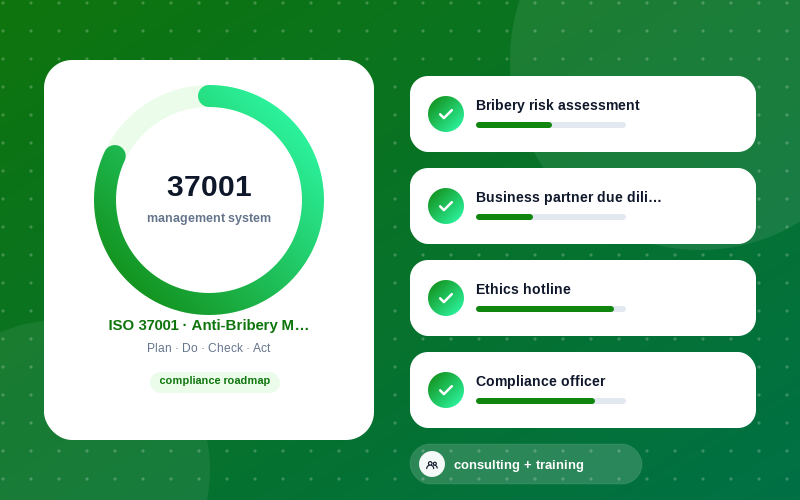
ISO 37001:2016

ISO 37001 consulting

Anti-bribery management systems — Requirements with guidance for use

ISO 37001 consulting

What is ISO 37001?

Provides anti-bribery management system requirements for preventing, detecting and addressing bribery.

Purpose and scope

To manage bribery risks and support an ethical culture.

Who is it suitable for?

Organizations with a high public profile, international operations or high-risk business partners.

Required processes

  • Bribery risk assessment
  • Business partner due diligence
  • Reporting and investigation processes
  • Training and awareness

Implementation stages

  1. Initial meeting and scope definition
  2. Current state (gap) analysis
  3. Implementation plan and role assignment
  4. Developing policies, processes and documents
  5. Implementation and employee training
  6. Internal audit and management review
  7. Support in preparing for the certification body's audit

Scope of consulting

  • Current state and gap analysis
  • System design and document preparation support
  • Employee awareness and implementation training
  • Internal audit support and corrective action tracking
  • Preparation for the certification audit (the certification decision does not rest with BDHA)

Training and implementation support

Awareness, implementation and internal auditor training for ISO 37001, together with implementation support throughout the process, is provided. Training and is not a consulting, certification or accreditation activity.

ISO 37001 consulting helps you establish an anti-bribery management system to prevent, detect and respond to bribery. Deliverables: bribery risk assessment, policy, due diligence procedures and certification readiness.

Bribery risk assessment

The work starts with an assessment that identifies where bribery risk may arise. Countries of operation, points of contact with public bodies, tenders, permit and licence processes, intermediaries and purchasing transactions are examined. The risks are then rated and the processes needing additional controls are recorded in a form that can be submitted for management approval.

Due diligence and business associates

Business associates, dealers, consultants and subcontractors are major sources of bribery risk. The engagement defines the due diligence questionnaire to be applied at partner selection and contracting, control steps that deepen with the risk level, and anti-bribery clauses to be added to contracts. Rules on gifts, hospitality and donations are also set out in writing with thresholds and approval flows.

Reporting channel, investigation and certification

The credibility of the system depends on employees and third parties being able to report suspicious situations without fear of retaliation. A confidential reporting channel, an independent review flow and links to disciplinary and legal processes are established. BDHA does not issue certification; certification is carried out by authorized, accredited bodies, while BDHA provides consulting and preparation.

What is included?

  • Bribery risk map: identifying and rating risks by country, sector, business model and contact with public officials.
  • Policy and governance roles: drafting the anti-bribery policy and defining the authorities and responsibilities of top management and the compliance function.
  • Due diligence: preparing risk-based screening forms and checklists for business associates, intermediaries and personnel.
  • Financial and commercial controls: arranging payment approvals, segregation of duties, gift and hospitality registers and rules on donations and sponsorship.
  • Training and reporting: setting up and testing role-based awareness training, a confidential reporting channel and the investigation process.

How we work

  1. Discovery

    Initial assessment: operating countries, public-sector relations, use of intermediaries and existing ethics practices are reviewed, and scope, responsible person and project timetable are set out in writing through meetings with management.

  2. Planning

    Risk and control design: the bribery risk assessment is completed, the policy and the procedures for due diligence, gifts and hospitality, reporting and investigation are drafted and reviewed with the relevant unit managers.

  3. Implementation

    Implementation and training: procedures take effect, targeted training is given to high-risk roles such as the board, purchasing, sales and finance, the policy is communicated to business associates and contract clauses are updated.

  4. Support

    Internal audit and certification readiness: internal audit, management review and corrective actions are completed, and the file and team are prepared for the audit by the authorized certification body.

What you gain

The processes and relationships where bribery risk concentrates become visible, and controls are applied in proportion to risk rather than at random.

Employees and business associates know through clear rules what is acceptable, and suspicious situations are reported through a safe channel and handled on the record.

The organization gains an anti-bribery management system, ready for a certification audit, with which it can demonstrate its integrity in tenders and the supply chain.

Who is it for?

This service is for organizations that take part in tenders, deal regularly with public bodies, manage dealer or intermediary networks abroad, or must meet the supplier compliance requirements of large corporate customers. Board members, general managers, legal and compliance officers, and purchasing and finance managers are the natural counterparts for this work.

Frequently Asked Questions

Does ISO 37001 guarantee that bribery is completely prevented?

No. The standard provides a management system framework aimed at reducing bribery risk to a reasonable level; it does not give absolute assurance. Its value lies in making risk identification, control implementation, reporting of concerns and continual improvement demonstrable. When operated this way, the system also serves as evidence of the care the organization has shown.

Which organizations is ISO 37001 suitable for?

The standard can be applied to public, private or non-profit organizations of any size and sector. It is particularly relevant for firms that take part in tenders, have frequent contact with public bodies, use intermediaries or dealers abroad, or must meet the supplier requirements of large customers. The depth of implementation is set according to the organization's bribery risk profile.

Related services and resources

The edition and validity status must be verified against the official ISO/IEC catalogue and the national standards body before publication.

Quote & demo

Let's evaluate your project together.

Let's start with a short call about QISO demo, ISO consulting, Artificial intelligence feasibility or your custom software needs.

  • QISO demo
  • ISO consulting
  • Artificial intelligence
  • Custom Software