

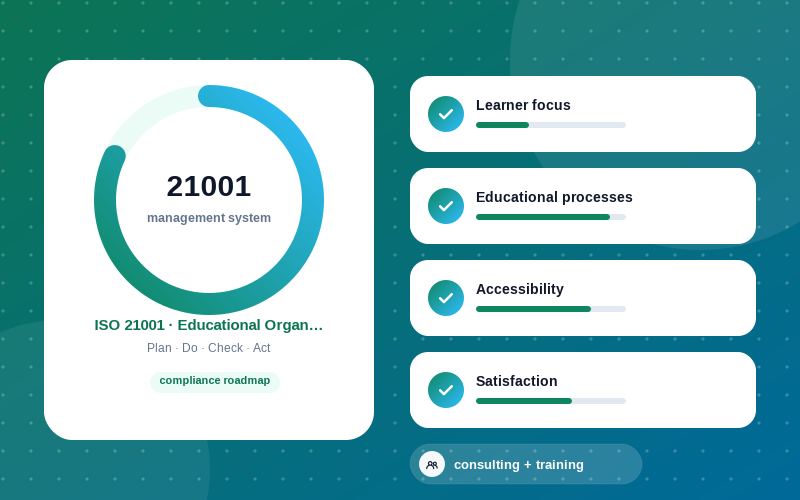
ISO 21001:2018

ISO 21001 consulting

Educational organizations — Management systems for Educational organizations — Requirements with guidance for use

ISO 21001 consulting

What is ISO 21001?

The management system standard that enables Education organizations to meet the needs of learners and other relevant interested parties.

Purpose and scope

To systematically plan, deliver and improve learner-focused educational services.

Who is it suitable for?

Schools, courses, universities and corporate training units.

Required processes

  • Learner needs analysis
  • Design and delivery of educational services
  • Measurement and evaluation
  • Feedback and improvement

Implementation stages

  1. Initial meeting and scope definition
  2. Current state (gap) analysis
  3. Implementation plan and role assignment
  4. Developing policies, processes and documents
  5. Implementation and employee training
  6. Internal audit and management review
  7. Support in preparing for the certification body's audit

Scope of consulting

  • Current state and gap analysis
  • System design and document preparation support
  • Employee awareness and implementation training
  • Internal audit support and corrective action tracking
  • Preparation for the certification audit (the certification decision does not rest with BDHA)

Training and implementation support

Awareness, implementation and internal auditor training for ISO 21001, together with implementation support throughout the process, is provided. Training and is not a consulting, certification or accreditation activity.

ISO 21001 consulting helps educational organizations set up a management system that meets the needs of learners and other interested parties. Deliverables: stakeholder analysis, process map, assessment methods and certification readiness.

A learner- and stakeholder-focused approach

ISO 21001 places the needs of parties such as learners, parents, employers, teaching staff and regulators at the centre of the system. In this work the expectations of each party that the organization must meet are identified and reflected in the design of the educational service, the teaching process and assessment practices. Quality thus becomes a management topic tied to learner outcomes, not just to regulatory compliance.

Designing and measuring educational processes

Processes such as enrolment, curriculum planning, course delivery, assessment, guidance and graduation are brought together in one process map. For each process an owner, inputs, outputs and indicators are defined, and data on attendance, satisfaction, achievement and feedback are monitored regularly. Accessibility and inclusion practices for learners with special needs are also treated as part of the system.

Competence, internal audit and certification readiness

The competence, professional development and performance evaluation of teaching staff are core elements of educational quality. The engagement sets up a competence matrix, an in-service training plan and an observation-based feedback method, followed by an internal audit and management review. BDHA does not issue certification; certification is carried out by authorized, accredited bodies, while BDHA provides consulting and preparation.

What is included?

  • Stakeholder analysis: identifying the expectations of learners, parents, employers and regulators and defining priorities and measurement methods.
  • Process map: defining enrolment, curriculum, teaching, assessment and guidance processes with owners, inputs, outputs and indicators.
  • Competence management: setting up a competence matrix for teaching staff, a professional development plan and a performance evaluation routine.
  • Inclusion and accessibility: planning adaptations, support and physical and digital access for learners with special needs.
  • Feedback and improvement: preparing satisfaction surveys, a complaint and suggestion flow, corrective actions and inputs for management review.

How we work

  1. Discovery

    Initial review: the institution's educational programmes, existing quality assurance practices and relevant regulatory expectations are reviewed, and scope, objectives and project timetable are set out in writing after talks with management and teaching staff.

  2. Planning

    System design: the stakeholder needs analysis, process map, quality policy, objectives and competence matrix are prepared, and existing documents are simplified into a structure that does not add to the workload of teaching staff.

  3. Implementation

    Implementation and training: the new processes are applied over one term, teaching and administrative staff receive hands-on training, satisfaction and achievement data are collected, and the system is reviewed together at the end of the first term.

  4. Support

    Internal audit and certification support: an internal audit suited to educational processes is conducted, management review is completed, nonconformities are closed and preparation is provided for the audit by the authorized certification body.

What you gain

Learner and parent expectations are collected and measured systematically, and the design of the educational service is improved on the basis of that data.

Process owners and teaching staff know their roles and responsibilities clearly, and attendance, achievement and satisfaction indicators are monitored regularly as input to management decisions.

The institution gains a sustainable management system for educational organizations, ready for a certification audit, through which it can demonstrate its approach to quality assurance.

Who is it for?

This service suits private schools, colleges, universities, language and course centres, vocational training institutions, corporate training academies and online education platforms. Founders, school and institution heads, quality and accreditation coordinators, and managers who want to make the quality of their educational service demonstrable are the natural counterparts for this work.

Frequently Asked Questions

How does ISO 21001 differ from ISO 9001?

ISO 9001 is a general quality management system standard that can be applied in any sector. ISO 21001 is a management system standard specific to educational organizations, with a stronger focus on the needs of learners, learner groups and other stakeholders, on inclusion and on the delivery of educational services. Because they share the same high-level structure, the two standards can be managed together in an integrated way.

Which types of educational organizations can implement ISO 21001?

The standard can be applied to any organization providing educational services: schools, colleges, universities, course and language centres, vocational training institutions, corporate training units and online education providers. The scope is set according to the programmes the institution offers and its learner groups. A small course and a large university rely on the same principles, but the level of detail differs.

Related services and resources

The edition and validity status must be verified against the official ISO/IEC catalogue and the national standards body before publication.

Quote & demo

Let's evaluate your project together.

Let's start with a short call about QISO demo, ISO consulting, Artificial intelligence feasibility or your custom software needs.

  • QISO demo
  • ISO consulting
  • Artificial intelligence
  • Custom Software