

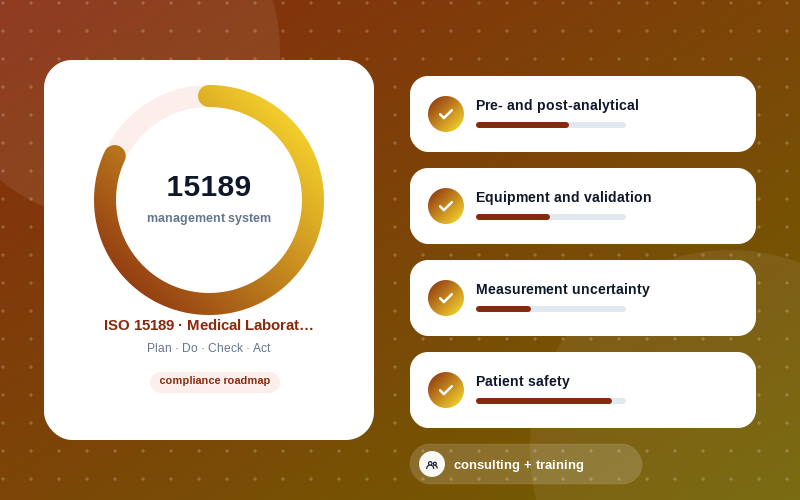
ISO 15189:2022

ISO 15189 consulting

Medical laboratories — Requirements for quality and competence

ISO 15189 consulting

What is ISO 15189?

The standard that defines the quality and technical competence requirements for medical laboratories.

Purpose and scope

Establishing a quality system that supports the reliability of Laboratory results and patient safety.

Who is it suitable for?

Hospital, private and reference medical laboratories.

Required processes

  • Pre-analytical, analytical and post-analytical processes
  • Equipment calibration and maintenance
  • Internal quality control and proficiency testing
  • Uncertainty and validation

Implementation stages

  1. Initial meeting and scope definition
  2. Current state (gap) analysis
  3. Implementation plan and role assignment
  4. Developing policies, processes and documents
  5. Implementation and employee training
  6. Internal audit and management review
  7. Support in preparing for the certification body's audit

Scope of consulting

  • Current state and gap analysis
  • System design and document preparation support
  • Employee awareness and implementation training
  • Internal audit support and corrective action tracking
  • Preparation for the certification audit (the certification decision does not rest with BDHA)

Training and implementation support

Awareness, implementation and internal auditor training for ISO 15189, together with implementation support throughout the process, is provided. Training and is not a consulting, certification or accreditation activity.

ISO 15189 consulting helps medical laboratories build a quality and technical competence system centred on patient safety and the reliability of results. Deliverables include procedures, a quality control plan, method verification files and records ready for an accreditation application.

Pre-examination, examination and post-examination processes

The whole flow is mapped, from specimen collection, labelling, transport, acceptance and rejection criteria through to reporting of results. Because most errors arise in the pre-examination phase, patient preparation, specimen acceptance criteria and critical value notification are defined in detail, and responsibilities and records are made clear.

Method verification and quality control

For every test in use, accuracy, precision, reportable range and reference intervals are verified, and measurement uncertainty is evaluated with suitable approaches. Internal quality control rules, control charts and participation in external quality assessment or interlaboratory comparison programmes are set up, and the workflow for handling deviations is defined.

Managing the accreditation process

BDHA does not grant certification or accreditation; these are carried out by authorised and accredited bodies. BDHA prepares the laboratory's application file, scope list and evidence records, plans the internal audit and management review, coaches staff for the questions that may arise during the assessment and supports the closure of findings.

What is included?

  • Quality management system: a framework is created that defines patient-focused policy, objectives, document control and the responsibilities of laboratory management.
  • Personnel competence: job descriptions, training plans, authorisation and competence assessment records are organised by laboratory section.
  • Equipment and metrological traceability: the instrument inventory, maintenance, calibration and verification plans secure the traceability of measurements.
  • Laboratory information system and data integrity: result transfer, access authorisation, backup and report approval processes are evaluated according to their risks.
  • Risk and improvement: nonconformities, complaints and quality indicators are monitored, and risk-based improvement and corrective actions are recorded.

How we work

  1. Discovery

    Gap analysis: the test menu, instruments, existing procedures and records are compared with the standard's requirements, and gaps are prioritised and reported to laboratory management.

  2. Planning

    Planning: the quality manager and section leads are appointed, and a verification schedule, document hierarchy and training plan are prepared into an implementation programme that does not disrupt routine work.

  3. Implementation

    Implementation: procedures, work instructions and record forms are released, method verification studies are carried out, quality control practices are started and staff receive on-the-job training.

  4. Support

    Assessment preparation and support: the internal audit and management review are completed, nonconformities are closed, and consulting continues during and after the accreditation assessment.

What you gain

The reliability of test results is supported by measurable quality control data, which strengthens the confidence that clinicians and patients place in the results.

Error risks are identified from specimen acceptance through to report authorisation, and steps that affect patient safety, such as critical value notification, become standardised.

The laboratory enters the accreditation assessment with organised documentation, current competence records and traceable measurements, and can sustain the system on its own after the audit.

Who is it for?

Suitable for hospital, outpatient and private medical laboratories, diagnostic centres, pathology and genetics laboratories, and blood centres. Laboratory directors, quality managers and technical managers, as well as healthcare organisation leadership preparing an accreditation application or wanting to mature an existing system, are the direct audience for this work.

Frequently Asked Questions

What is the difference between ISO 15189 and ISO/IEC 17025?

ISO 15189 is specific to medical laboratories and contains requirements on patient care, clinical advice and the processes before and after the examination. ISO/IEC 17025 addresses the general competence of testing and calibration laboratories. The two standards share many technical principles, but for medical laboratories ISO 15189 is the primary reference.

Is the standard also applicable to a small laboratory?

Yes. Outpatient clinic laboratories, hospital laboratories and independent centres can all apply the standard. The system is simplified according to scale: the document and record burden is kept proportionate by considering the test menu, staff numbers and instrument set-up. The basic condition is that the reliability of results can be demonstrated with method verification and quality control records.

Related services and resources

The edition and validity status must be verified against the official ISO/IEC catalogue and the national standards body before publication.

Quote & demo

Let's evaluate your project together.

Let's start with a short call about QISO demo, ISO consulting, Artificial intelligence feasibility or your custom software needs.

  • QISO demo
  • ISO consulting
  • Artificial intelligence
  • Custom Software