

Integration Services

LDAP Integration | Integration Services

We set up authentication and user-mapping integrations with your LDAP directory services.

LDAP Integration – image 1
LDAP Integration – image 2

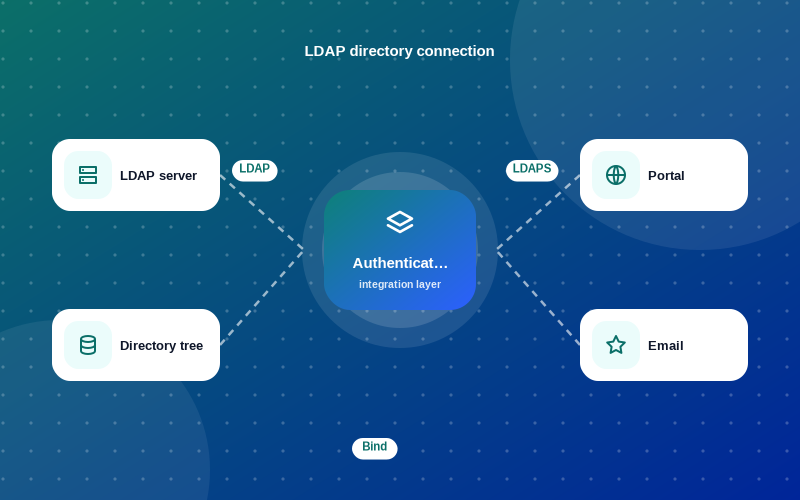
We securely connect your applications to LDAP-compatible directory services such as OpenLDAP, 389 Directory Server or Active Directory, and set up authentication, user and group mapping and redundant scenarios. Deliverables include the connection design, search rules, test records and operations notes.

Reading directory data correctly: bind and search

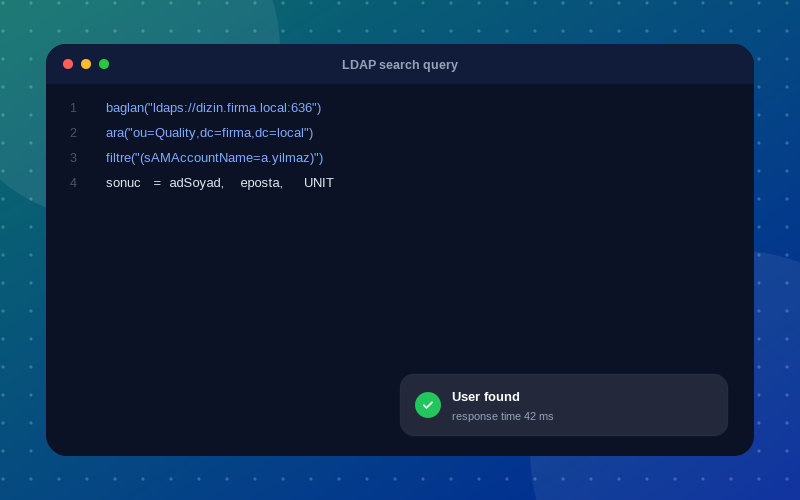
The quality of an LDAP integration depends on designing the bind and search rules correctly. A common approach is to bind to the directory with a service account, search for the user and then authenticate with the user's own credentials. Base DN, search scope, filters and attribute selection are determined by your directory structure, which prevents wrong-person matches and unnecessary load.

Encrypted connections and secure credential handling

With unencrypted LDAP traffic, passwords can travel across the network in the clear. For this reason the connection is made with LDAPS or StartTLS, the server certificate is validated and a certificate renewal process is planned. The service account holds only read and search rights; its password is not left as plain text in a configuration file but stored in a protected location and designed to be changeable regularly.

Redundancy, performance and failure scenarios

When authentication stops working, all users are affected; for this reason several directory servers are defined, connection timeouts and retry intervals are tuned and pooled connections are used. If one server does not respond, the next is used. In large directories, paged search and attribute limiting are applied; short-lived caching is used only if your security policy allows it.

What is included?

  • Authentication flow: Setting up the service-account search and user-credential bind steps, including failed-login and locked-account handling.
  • User and group mapping: Mapping LDAP attributes and group memberships to application user fields and roles, including nested groups.
  • Secure connection: LDAPS or StartTLS, certificate chain validation, appropriate encryption settings and planning of the certificate renewal process.
  • Redundant scenarios: Setting up multiple directory servers, timeout and retry settings and the fallback approach that takes over when a server fails.
  • Monitoring and logging: Keeping failed authentication, connection error and latency logs free of passwords, plus a troubleshooting guide.

How we work

  1. Discovery

    We examine the type of directory service, its schema, user and group tree and the network ports it uses, and determine which attribute the application uses to find users and which groups serve as roles.

  2. Planning

    We write the connection design, listing the base DN, search filter, attribute mapping, certificate and service account requirements, and plan the necessary access permissions together with your security and network teams.

  3. Implementation

    We set up the connection against a test directory and try one by one the scenarios of valid and wrong passwords, a locked account, usernames with spaces or special characters, nested groups and a server outage, recording each.

  4. Support

    We move to the production directory with a pilot of first users, watch search times and error logs, refine settings and hand over troubleshooting steps along with the operations notes.

What you gain

Credentials are kept in a single directory and carried encrypted over the network; the need to manage a separate password database inside the application disappears.

Role assignment based on group membership removes the burden of making permission changes user by user and creates a traceable basis for access reviews.

When a directory server fails, authentication either continues or is handled in a controlled way; error logs make it quick to tell whether the problem is in the directory, the network or the application.

Who is it for?

This service suits organizations that use OpenLDAP, 389 Directory Server or a similar directory service as their identity source and want their applications to authenticate against it. It is aimed at IT teams with Linux-heavy infrastructure, those wanting to avoid managing separate passwords across many applications, or those using an independent directory.

Frequently Asked Questions

What is the difference between LDAP and LDAPS, and which should we use?

Plain LDAP traffic is unencrypted; a user's password can travel across the network in readable form. LDAPS encrypts the connection with TLS from the start, while StartTLS upgrades an open connection to an encrypted one. We do not recommend unencrypted connections for authentication; depending on your directory server's support, we set up LDAPS or StartTLS with certificate validation.

Do you get access to users' passwords during the LDAP integration?

No. During authentication, the password the user types is used only in the attempt to bind to the directory server; the application does not store it or write it to logs. During setup only the service account details are needed; this account is created by you with least privilege and its password is managed securely.

Related services and resources

Quote & demo

Let's evaluate your project together.

Let's start with a short call about QISO demo, ISO consulting, Artificial intelligence feasibility or your custom software needs.

  • QISO demo
  • ISO consulting
  • Artificial intelligence
  • Custom Software