

Custom Software & Enterprise Technology

ERP Solutions | Custom Software and Enterprise Technology

We unite your purchasing, inventory, finance and production processes in an ERP structure tailored to your business.

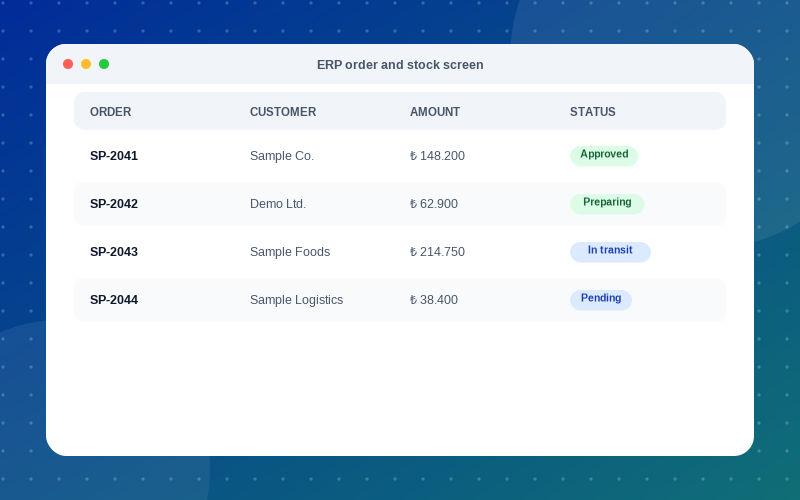
ERP Solutions – image 1
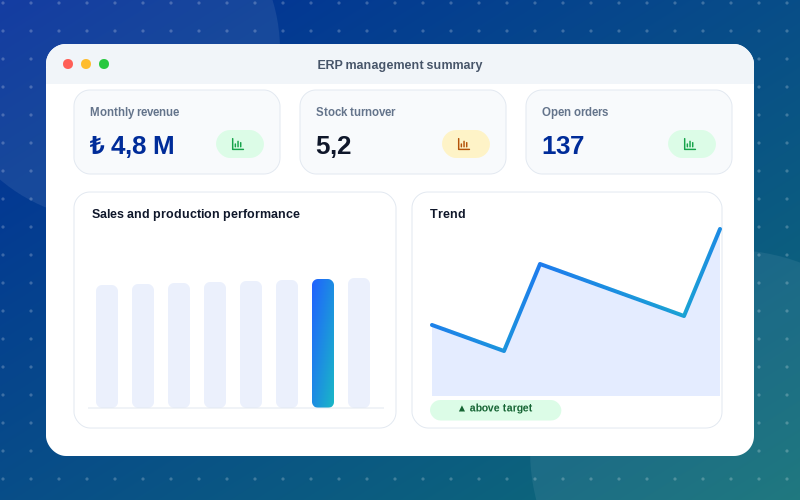
ERP Solutions – image 2

We unite your purchasing, inventory, finance and production processes in a modular ERP structure designed around how your business actually works. Deliverables are the working system, data migration, role and permission structure and a reporting set.

Process-driven, modular design

Rather than forcing a ready-made ERP package onto the business, we first map flows from purchase request to invoice and from stock movement to costing. Modules are configured around these flows, leaving out features that would never be used. The modular structure lets the system go live first with the most urgent process and then expand into areas such as production, accounting or sales.

Data migration from existing systems

Data migration is often the riskiest part of an ERP project. We inventory data from legacy systems and spreadsheets such as customer and supplier accounts, item masters, bills of materials and open orders, clean up duplicate and faulty records and map them to the new structure. We rehearse the migration in a test environment and verify it by record counts and balance reconciliation, keeping business interruption at go-live to a minimum.

Role-based authorization and reporting

An ERP is a system in which many departments see the same data, so the permission structure must be designed from the outset. Roles are defined so that a buyer sees and processes only their own requests and orders, an accountant the financial records and a warehouse clerk the stock movements, with approval limits and segregation of duties applied. Management dashboards and operational reports are fed from a single data source through these roles.

What is included?

  • Process analysis: We examine purchasing, inventory, finance and production flows on site and document the current practices and improvement points.
  • Module design: We configure purchasing, inventory, accounts, accounting and production modules to the business, including coding structure and approval flows.
  • Data migration: We cleanse and map data from legacy systems and spreadsheets, verify it through trial migrations and prepare the go-live plan.
  • Authorisation and approval structure: We define roles, approval limits and segregation-of-duties rules and hand user and group administration to the relevant departments.
  • Reporting and integration: We set up management dashboards, operational reports and integrations with banks, e-documents or other systems, and deliver user training.

How we work

  1. Discovery

    Working with each department, we document existing processes, the spreadsheets and software in use, approval chains and problem areas, and put the ERP scope into writing with prioritised modules and acceptance criteria.

  2. Planning

    We design the module and data model, coding structure, roles and permissions, review drafts of screens and reports with users, and record any requirement changes.

  3. Implementation

    We build the modules, carry out a trial migration of legacy data, run user acceptance tests with scenarios and fix the defects found before going live.

  4. Support

    We carry out the go-live to a planned schedule, provide close support and afterwards continue regular support and release management for maintenance, improvements and new module needs.

What you gain

Purchasing, inventory, finance and production work on the same data, manual hand-offs and conflicting records between departments decrease, and processes become traceable end to end.

Managers reach current stock, open orders, cost and balance information from a single source, and decisions can be made without waiting for period-end reports.

Roles, approval limits and segregation of duties reduce the risk of unauthorised access and erroneous transactions, and create traceable records for internal control and audit work.

Who is it for?

This service is for manufacturing, trading and service businesses that run purchasing, inventory, finance and production on spreadsheets or disconnected programs and find that off-the-shelf packages do not fit their way of working. It suits managers who want to replace their current system, ensure data consistency between departments and obtain management reports from one place.

Frequently Asked Questions

Should we choose a ready-made ERP package or custom development?

It depends on how standard your processes are. If they fit common practice, a ready-made package may be more economical; if you have business-specific rules, a particular production structure or integration needs, a tailored build is more suitable. In the analysis before the decision we compare both options together in terms of cost, flexibility and maintenance.

Will daily operations be disrupted during the ERP transition?

To reduce the risk of disruption we split the transition into stages, rehearse it first in a test environment and schedule go-live for a period of low workload. If necessary, the old and new systems run in parallel for a short time. Some adjustment period is still natural, which is why training and close support are planned.

Related services and resources

Quote & demo

Let's evaluate your project together.

Let's start with a short call about QISO demo, ISO consulting, Artificial intelligence feasibility or your custom software needs.

  • QISO demo
  • ISO consulting
  • Artificial intelligence
  • Custom Software