

Custom Software & Enterprise Technology

Software Modernization | Custom Software & Enterprise Technology

We migrate your applications running on legacy technology to a current infrastructure without disrupting business continuity.

Software Modernization – image 1
Software Modernization – image 2

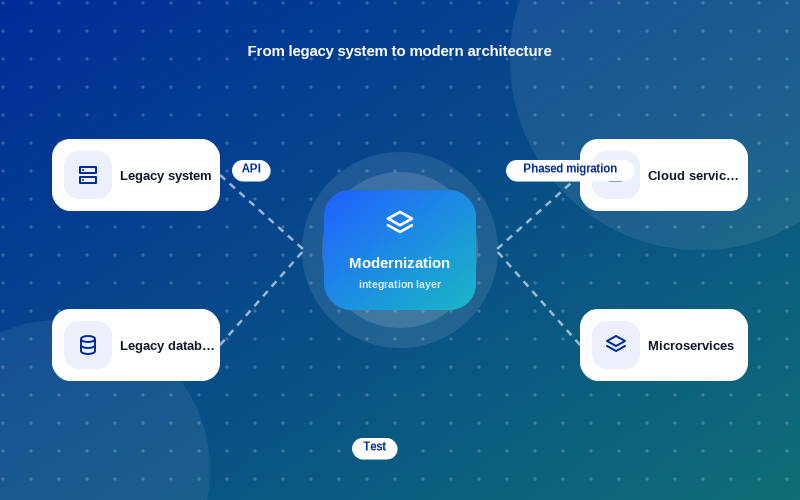
BDHA moves applications that run on legacy technology to a current platform without disrupting business continuity. The existing code and architecture are analysed; a phased migration plan, the modernised application and post-migration support are delivered.

Current-state analysis and modernisation strategy

We begin by examining the source code, database schema, dependencies and deployment structure. Based on the findings, the options of lifting the application onto a new platform as it is, restructuring it, or rewriting it piece by piece are compared on cost, risk and benefit, and a written strategy is presented for management to decide on.

Phased migration for uninterrupted operations

Rather than replacing the whole system in one go, we proceed module by module. Old and new components run side by side for a period; data migration is checked with reconciliation reports, and a rollback plan is kept ready at every stage. This lets users carry on with their daily work without interruption.

Performance, security and maintainability improvements

During the migration, frameworks and libraries that are out of support are updated, known security vulnerabilities are closed, and slow queries and unnecessary dependencies are cleaned up. The code is structured to be testable, and documentation and an automated deployment pipeline are added so the application can be maintained at low cost in the years ahead.

What is included?

  • Code and architecture analysis: Source code quality, technical debt, dependencies and unsupported components are reviewed and summarised in a findings report.
  • Migration plan: Module sequence, cut-over window, data migration method and rollback scenarios are planned together with a risk assessment.
  • Platform upgrade: We upgrade .NET, database, operating system or web server versions to suit the target platform.
  • Interface and usability: Legacy desktop or server-rendered interfaces can be converted into modern, browser-based and mobile-friendly screens.
  • Validation and handover: Regression tests, user acceptance testing and administrator documentation secure day-to-day operation after the cut-over.

How we work

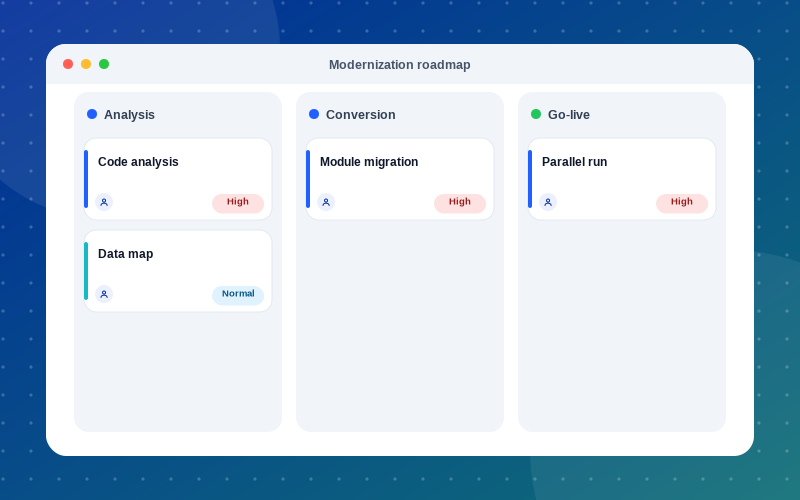
  1. Discovery

    We inventory the application's functions, user roles, integrations and infrastructure; critical workflows are identified, and risks in code, data and deployment are collected in an analysis report.

  2. Planning

    The target architecture, technology stack and migration method are selected; a phased plan divided into modules is submitted for stakeholder approval together with a timeline and rollback conditions.

  3. Implementation

    Modules are moved to the new platform in sequence; data transfer is verified with reconciliation reports, regression tests are run, and users are involved in trying the new version in a test environment.

  4. Support

    Go-live takes place in the planned window; close monitoring and fast bug fixing are provided during the first weeks, followed by a maintenance and support process with continuous improvement proposals.

What you gain

Business continuity is preserved while you move off unsupported technologies; the application runs on a platform that can receive current security patches.

Performance bottlenecks and technical debt are reduced, and the code structure becomes suitable for new development and test automation.

A solid foundation emerges for new features, integrations and mobile access, so later investments are not held back by the constraints of old code.

Who is it for?

This service suits organisations whose business applications were built years ago, run on frameworks or server versions that are no longer supported, and have become hard to change. IT managers with partly documented systems, security and compliance officers, and teams wanting to extend a system with mobile access, integrations or new modules benefit from it.

Frequently Asked Questions

Is it better to rewrite the application from scratch or to migrate it?

There is no single right answer; it depends on code quality, how well business rules are documented, the budget and the acceptable downtime. During the analysis phase we compare the options on cost, risk and duration. In many cases, phased migration with selective rewriting proves more predictable than a complete rewrite.

Can users keep using the system during the migration?

Usually yes. We run the old and new versions in parallel for a period and cut over by module or user group. Steps that require a short outage are scheduled for low-activity hours and announced in advance. Because a rollback path is kept ready at every stage, you can return to the previous state if an unexpected problem occurs.

Related services and resources

Quote & demo

Let's evaluate your project together.

Let's start with a short call about QISO demo, ISO consulting, Artificial intelligence feasibility or your custom software needs.

  • QISO demo
  • ISO consulting
  • Artificial intelligence
  • Custom Software