

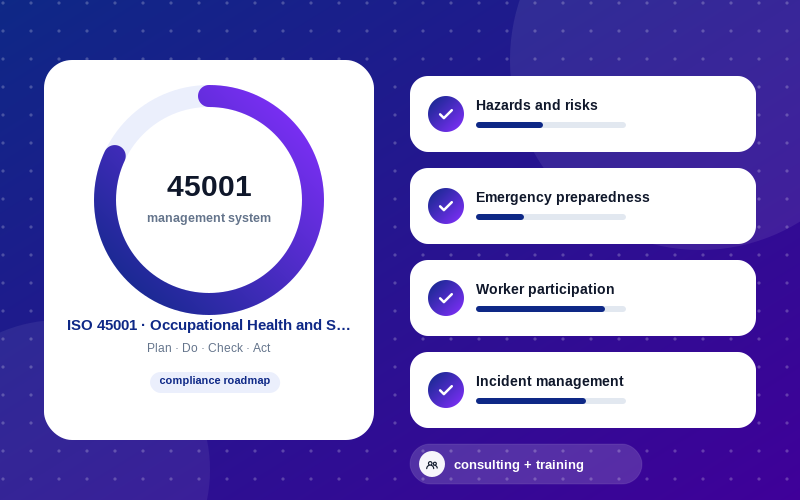
ISO 45001:2018

ISO 45001 consulting

Occupational health and safety management systems — Requirements

ISO 45001 consulting

What is ISO 45001?

A management system standard that aims to create a safe and healthy workplace for employees and to prevent injuries and work-related ill health.

Purpose and scope

Managing OHS risks and reducing the likelihood of workplace accidents and occupational diseases.

Who is it suitable for?

Any organization in manufacturing, construction, energy and logistics, regardless of headcount.

Required processes

  • Hazard identification and risk assessment
  • Incident and near-miss management
  • Emergency plans
  • Employee participation and training

Implementation stages

  1. Initial meeting and scope definition
  2. Current state (gap) analysis
  3. Implementation plan and role assignment
  4. Developing policies, processes and documents
  5. Implementation and employee training
  6. Internal audit and management review
  7. Support in preparing for the certification body's audit

Scope of consulting

  • Current state and gap analysis
  • System design and document preparation support
  • Employee awareness and implementation training
  • Internal audit support and corrective action tracking
  • Preparation for the certification audit (the certification decision does not rest with BDHA)

Training and implementation support

Awareness, implementation and internal auditor training for ISO 45001, together with implementation support throughout the process, is provided. Training and is not a consulting, certification or accreditation activity.

ISO 45001 is the occupational health and safety management system standard aimed at creating a safe and healthy workplace and preventing injury and ill health. BDHA provides consulting from risk assessment through to certification readiness.

Hazard identification and risk assessment

At the heart of the system is identifying workplace hazards on site, assessing risks by likelihood and severity and selecting control measures. Measures are considered in the order of elimination, substitution, engineering controls, administrative arrangements and personal protective equipment. Non-routine work, contractor activities and changes are also included in the assessment.

Worker participation, consultation and incident management

ISO 45001 explicitly requires workers and their representatives to take part in hazard reporting, risk assessment and incident investigation. Recording near misses, work accidents and occupational diseases, root cause analysis and tracking of corrective actions form the learning mechanism of the system. Emergency plans, drills and first-aid arrangements are planned and recorded within this framework.

Certification and the role of BDHA

BDHA does not issue the ISO 45001 certificate; certification is carried out through an independent audit by authorised and accredited certification bodies. BDHA provides consulting and preparation: system set-up, support with risk assessment, training, internal audit and management review. Legal responsibilities under legislation, such as appointing a safety specialist and workplace physician, remain with the organisation, and consulting does not replace them.

What is included?

  • Hazard and risk analysis: Hazards are identified on site in all units, risks are rated and control measures are recorded in order of priority.
  • Legal requirements and responsibilities: Applicable occupational health and safety legislation, obligations and the allocation of duties are listed, and compliance is evaluated regularly.
  • Incident and near-miss management: Reporting, investigation and corrective action processes for work accidents, near misses and occupational diseases are set up and tracked through records.
  • Emergency preparedness and training: Emergency plans, evacuation drills, first-aid arrangements and role-based safety training are planned.
  • Contractor and visitor control: Safety requirements, access rules and joint risk assessment are arranged for subcontractor and contractor activities.

How we work

  1. Discovery

    We review your workplace, shift pattern, equipment and chemicals on site, gather your existing safety records, accident statistics and legal files, and define the scope of the system.

  2. Planning

    Together with worker representatives we carry out hazard walk-throughs and the risk assessment, set the policy, objectives and role responsibilities, and have the action plan approved by management.

  3. Implementation

    We put instructions, incident reporting, training and emergency arrangements into effect, run drills with you and verify through observation and records that the practice works on site.

  4. Support

    We prepare you for the certification audit through internal audit, management review and closing of nonconformities, and afterwards help keep the system working for surveillance audits.

What you gain

Workplace hazards are known and controlled, and accidents and near misses are investigated systematically, reducing the risks of injury and lost working days.

Workers take part in the process and a safety culture develops; because roles, authorities and training are clear, responsibilities do not depend on a single person.

You make your legal obligations traceable, enter the ISO 45001 certification audit well prepared and can provide evidence for customer and tender expectations.

Who is it for?

This service suits organisations carrying out higher-risk work such as manufacturing, construction, energy, logistics and warehousing, and any business wanting to manage worker safety systematically. It targets management teams seeking an occupational health and safety certificate because of customer or tender requirements, or wanting to organise contractor management and reduce the cost of work accidents.

Frequently Asked Questions

Does ISO 45001 consulting replace appointing a safety specialist?

No. Appointing a safety specialist, workplace physician and other roles required by legislation is the organisation's legal responsibility. ISO 45001 consulting helps make these obligations orderly and traceable within the management system, but it does not replace legal appointments or on-site responsibilities.

Does ISO 45001 make sense for an office-based company?

Yes. Offices also involve risks such as ergonomics, screen work, psychosocial pressure, emergency exits, electrical safety and site visits. The scope of the system is set according to the risk level of the activities, and in low-risk businesses processes are kept leaner and unnecessary documentation is avoided.

Related services and resources

The edition and validity status must be verified against the official ISO/IEC catalogue and the national standards body before publication.

Quote & demo

Let's evaluate your project together.

Let's start with a short call about QISO demo, ISO consulting, Artificial intelligence feasibility or your custom software needs.

  • QISO demo
  • ISO consulting
  • Artificial intelligence
  • Custom Software