

Integration Services

Payroll Systems Integration | Integration Services

We ensure that payroll-sourced data is transferred to the relevant applications in a controlled way.

Payroll Systems Integration – image 1
Payroll Systems Integration – image 2

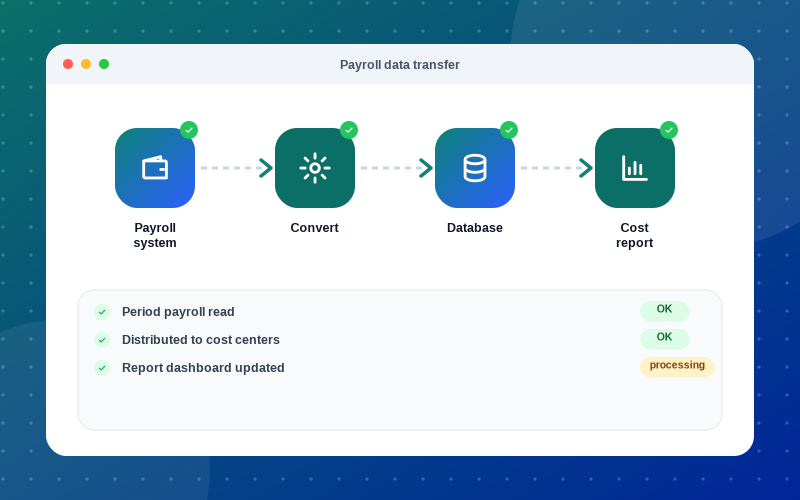
We transfer timesheet, leave, expense and cost data from your payroll system to the relevant applications in a controlled way, via files or services. Deliverables include the transfer design, masking and access rules, scheduled transfer jobs and periodic reconciliation reports.

Sharing sensitive data only as far as needed

Payroll data is among an organization's most sensitive information. For needs such as cost reporting or project time tracking, a total per department is often enough rather than individual salaries. In transfer design we analyze needs field by field, leave out unnecessary fields, mask or aggregate the required ones and restrict access to authorized roles.

File or service: choosing the right transfer method

Many payroll applications only produce scheduled file output, while some offer a service interface. With the file method, CSV, XML or fixed-width files dropped in a shared folder or secure transfer server are read, validated and processed. With the service method, data is pulled through authenticated calls. In both cases, reprocessing and duplicate-record protection are designed in.

Period close and reconciliation discipline

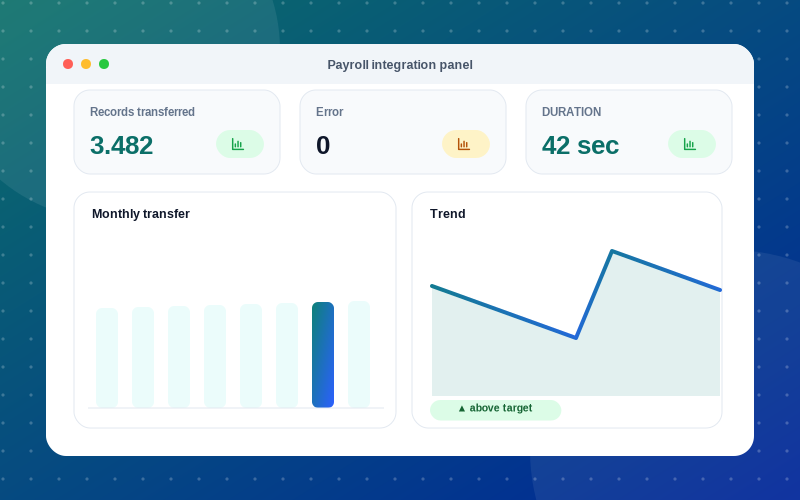
Payroll runs in periods, so the transfer is tied to period logic as well. When a period closes, the number of records transferred and the totals are compared with the source, and any difference is listed at line-item level. If a correction is made on the payroll side, the same period can be retransferred and the old data is replaced in a traceable way. Finance and HR therefore work with the same figures during close.

What is included?

  • Timesheet and leave data: Consistent transfer of working hours, overtime and leave records between payroll and task tracking or production applications.
  • Cost transfer: Sending personnel costs aggregated by department, cost center and project to finance and reporting systems.
  • File processing: Collecting CSV, XML and fixed-width files from a secure folder, validating their format, archiving them and separating faulty files.
  • Masking and authorization: Removing or masking sensitive fields, least-privilege rights for the transfer account and encryption of files in transit.
  • Periodic reconciliation: Record count and amount comparison, a line-item difference list and a period retransfer procedure.

How we work

  1. Discovery

    We review the payroll system's output formats, period calendar and the data the target applications need, and clarify with HR, finance and information security which fields are genuinely necessary.

  2. Planning

    We prepare the transfer design, put file naming, folder structure, encryption, masking, scheduling and failure notification rules in writing, and submit them for your approval with respect to confidentiality obligations.

  3. Implementation

    We develop the transfer jobs and test format, boundary values and error scenarios with anonymous sample files, demonstrating that cases such as duplicate files, missing fields and corrupted encoding are handled correctly.

  4. Support

    In the first real period we monitor the transfer live with the payroll team and verify the reconciliation report; in later periods we continue support, adaptation to format changes arising from regulation and schedule adjustment.

What you gain

Payroll data is shared only at the required level of detail and over encrypted channels, without reaching unauthorized people; confidentiality obligations are supported technically.

At period close, finance and HR work with the same figures; because differences are visible at line-item level, the manual checking and correspondence load during close decreases.

Transfers become scheduled, logged and repeatable; a faulty file is noticed through a same-day notification instead of coming as a surprise in the next period.

Who is it for?

This service suits organizations that want to use payroll data in finance, project tracking, production planning or reporting applications while putting confidentiality and accuracy first. It is aimed at organizations where HR, finance and information security teams decide jointly and want to speed up period close and stop moving files by hand.

Frequently Asked Questions

Does individual salary information have to reach the target application when payroll data is transferred?

No, in most scenarios it does not. For uses such as cost reporting, capacity planning and project profitability, an amount aggregated by department or cost center is enough. If person-level data is needed, the field is masked or restricted so only authorized roles can see it. We clarify the scope with you in writing.

What happens if our payroll software vendor does not allow external intervention?

We work without touching the payroll system, using only the standard export outputs the vendor supports. The file-based method suits this situation: the system produces the output and we read it. In the preliminary analysis we review the limits in your vendor contract together and, if needed, coordinate with your vendor.

Related services and resources

Quote & demo

Let's evaluate your project together.

Let's start with a short call about QISO demo, ISO consulting, Artificial intelligence feasibility or your custom software needs.

  • QISO demo
  • ISO consulting
  • Artificial intelligence
  • Custom Software