

ISO 9001:2015

ISO 9001 Consulting

Quality management systems — Requirements

ISO 9001 Consulting

What is ISO 9001?

The international standard that defines the quality management system requirements that enable organizations to consistently deliver products and services that meet customer expectations and legal requirements.

Purpose and scope

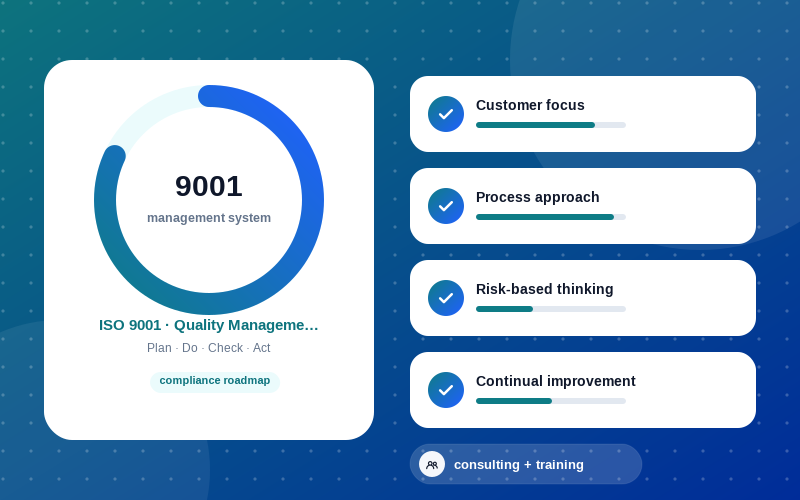
To increase customer satisfaction through a process approach, risk-based thinking and continual improvement.

Who is it suitable for?

Organizations of every size and sector, including manufacturing, services and the public sector.

Required processes

  • Document and record control
  • Internal audit
  • Corrective action
  • Management review
  • Supplier evaluation

Implementation stages

  1. Initial meeting and scope definition
  2. Current state (gap) analysis
  3. Implementation plan and role assignment
  4. Developing policies, processes and documents
  5. Implementation and employee training
  6. Internal audit and management review
  7. Support in preparing for the certification body's audit

Scope of consulting

  • Current state and gap analysis
  • System design and document preparation support
  • Employee awareness and implementation training
  • Internal audit support and corrective action tracking
  • Preparation for the certification audit (the certification decision does not rest with BDHA)

Training and implementation support

Awareness, implementation and internal auditor training for ISO 9001, together with implementation support throughout the process, is provided. Training and is not a consulting, certification or accreditation activity.

ISO 9001 defines the quality management system requirements that help organisations consistently deliver products and services meeting customer expectations and legal requirements. BDHA provides consulting for setting up the system, documentation, internal audits and certification readiness.

Process approach and risk-based thinking

ISO 9001:2015 expects an organisation to treat its activities as interrelated processes and to define the inputs, outputs, owner, resources and performance indicators of each. Risk-based thinking helps identify threats and opportunities before problems occur. In the consulting work, the process map, process cards and risk records are built together with you, following the real flow of your business.

Documented information, customer focus and improvement

The standard does not call for unnecessary paperwork; it requires information that demonstrates effectiveness, such as the quality policy, objectives, process descriptions and records, to be kept under control. Customer feedback, complaints, satisfaction measurements, supplier performance and internal audit findings feed into management review. The aim is to improve the system continually through corrective action.

Certification and the role of BDHA

BDHA does not issue the ISO 9001 certificate; certification is granted after an independent audit by authorised and accredited certification bodies. BDHA's role is consulting and preparation: building the system, training staff, carrying out the internal audit and helping you enter the certification audit fully prepared. The choice of certification body and the audit outcome remain with your organisation.

What is included?

  • Gap analysis: Processes, documents and practices are reviewed against ISO 9001 requirements, and gaps and priority improvement areas are reported.
  • Process map and KPI design: Process interactions, responsibilities and performance indicators are defined, and measurement frequency and target values are set.
  • Documentation system: The quality manual, procedures, work instructions, forms and records control are prepared in a lean, traceable form suited to the organisation's size.
  • Training and internal audit: Awareness training is given to top management and staff, internal auditors are developed and planned internal audits are carried out.
  • Management review and certification readiness: Inputs are compiled, CAPA records are closed and a rehearsal assessment is carried out before the certification audit.

How we work

  1. Discovery

    We examine your field of activity, products and services, and customer and legal expectations, and define with management the scope of the system, any excluded requirements and the project team.

  2. Planning

    We plan processes, risks and objectives, hold workshops with process owners to map existing practices to the standard's requirements, and build a schedule for closing the gaps.

  3. Implementation

    We put documents and records into use, train staff and let the system run in practice for a period, then carry out an internal audit, close nonconformities through CAPA and hold the management review.

  4. Support

    We help you plan the audit with the certification body, provide preparation support on audit days and, after certification, help you keep the system alive for surveillance audits.

What you gain

You build a management system with clear processes, responsibilities and measurement methods, so work depends on defined, traceable processes rather than on individuals.

Customer complaints, nonconformities and audit findings are recorded systematically, closed through root cause analysis, and recurring errors decrease.

You enter the ISO 9001 certification audit well prepared and meet surveillance audits afterwards with a sustainable internal routine.

Who is it for?

This service suits manufacturing and service businesses seeking a quality certificate because of customer or tender requirements, growing companies wanting to standardise their processes, and organisations aiming to align an existing system with ISO 9001:2015. It can be adapted to organisations of any sector and size.

Frequently Asked Questions

Does BDHA issue the ISO 9001 certificate?

No. Certification is granted through an independent audit by authorised and accredited certification bodies. BDHA provides consulting so you can prepare for that audit: we build the system, train staff and perform the internal audit. You choose the certification body, and no guarantee is given about the audit result.

Would setting up ISO 9001 be too heavy for a small business?

The standard can be adapted to the size and activities of the organisation. In small businesses the number of documents is kept lean and only records that demonstrate effectiveness and are actually used are created. The aim of the consulting is not to produce a pile of paperwork but to build a right-sized system that helps you manage your business in a more orderly way.

Related services and resources

The edition and validity status must be verified against the official ISO/IEC catalogue and the national standards body before publication.

Quote & demo

Let's evaluate your project together.

Let's start with a short call about QISO demo, ISO consulting, Artificial intelligence feasibility or your custom software needs.

  • QISO demo
  • ISO consulting
  • Artificial intelligence
  • Custom Software