

Artificial Intelligence & Intelligent Business Processes

Business Process Automation | Artificial Intelligence & Intelligent Business Processes

We automate repetitive, rule-based and document-heavy tasks so your teams can focus on higher-value work.

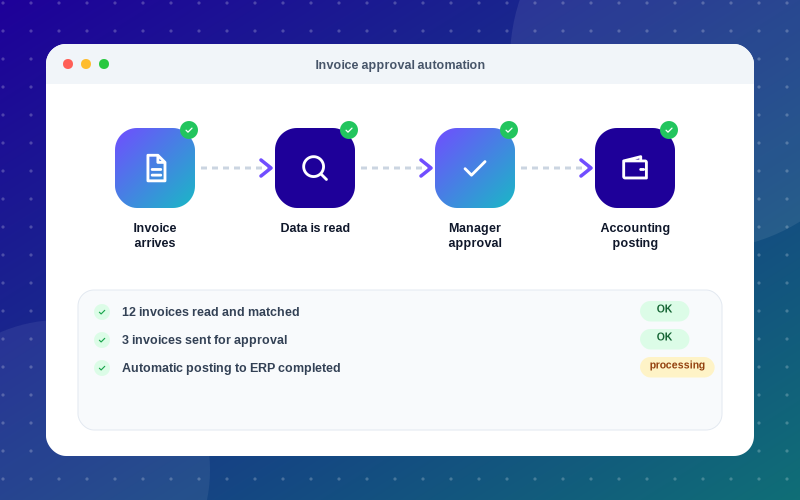
Business Process Automation – image 1
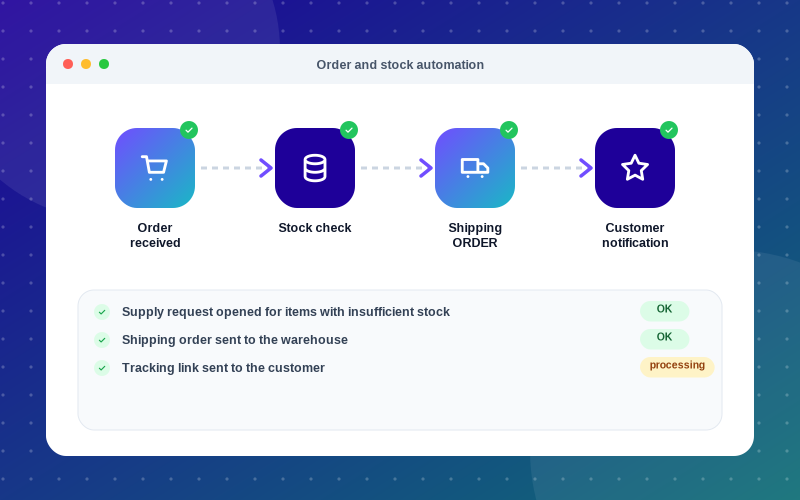
Business Process Automation – image 2

Business process automation uses software and artificial intelligence to automate repetitive, rule-based and document-heavy steps. The deliverables are a process analysis, automated workflows, approval and exception rules, and traceable records.

Which steps are genuinely suitable for automation?

Not every step is worth automating. We first map the process end to end and examine each step's duration, frequency, error rate and rule clarity. Repetitive tasks such as entering invoice data, validating orders, classifying documents or compiling reports are candidates, while decisions that require judgment stay with people. The result is a reasoned list of automation candidates.

Approval, exception and human handover flows

Real processes are full of unexpected cases. We do not build automation for the happy path only; we also define rules for exceptions such as a missing document, an inconsistent amount, a limit breach or an unauthorized request. In those cases the work is routed to the right person with the required information and a deadline. Approval steps follow roles and amount thresholds and account for delegation and absence.

Traceable and auditable automation

Without visibility into what an automated task does, there is no trust. For every flow instance we record the start time, processed data, applied rule, approver and outcome. Steps that fail raise alerts and can be retried. Process owners follow pending items, bottlenecks and exception rates in a dashboard and can use the records as evidence in internal audits and external reviews.

What is included?

  • Process analysis and automation candidates: The current flow is mapped, steps are scored on duration, volume and error criteria, and priority candidates are selected.
  • Document processing: Extraction, classification and validation of data from invoices, forms and correspondence are built using rules and artificial intelligence together.
  • Approval and exception flows: Routing by role, amount and department, delegation, reminders and escalation on overdue items are defined.
  • System connections: Integrations with ERP, email, file shares and databases are built, with safe methods chosen for systems that have no usable interface.
  • Monitoring and audit trail: For every transaction we keep who completed it, when and under which rule, and bottlenecks are tracked through a dashboard and alerts.

How we work

  1. Discovery

    Working with process owners, we observe the current flow, document the forms, emails and systems in use, and measure manual workload and the most common error types.

  2. Planning

    We design the target flow with its rules, exceptions and approval hierarchy, and confirm with a walkthrough that the steps were interpreted correctly before submitting it for your approval.

  3. Implementation

    We build the automation, run it in parallel on a sample of real historical records, compare results with manual work and correct any deviations.

  4. Support

    We go live in stages, train the team on usage and exception handling, and then maintain the monitoring dashboard and rule updates through regular improvement meetings.

What you gain

Because repetitive work is handed to software, teams can spend more time on value-adding work such as analysis, customer relations and improvement.

Process steps follow the same rule every time, so data entry errors, skipped approvals and lost documents decrease and results no longer depend on the individual.

Because every transaction is recorded, it becomes easier to show evidence in internal and external audits, find bottlenecks and improve the process with data.

Who is it for?

This service suits managers in finance, procurement, human resources, sales operations and quality whose invoices, orders, requests or forms are still handled through email, spreadsheets and manual entry. It is aimed at businesses of any size that want auditable processes and wish to free their teams from repetitive work.

Frequently Asked Questions

Does automation remove employees' jobs?

Our aim is not to remove human work but to take over repetitive, low-value steps. Judgment, customer communication and exception handling stay with people. In automation design we consider team roles together with you and help you plan how employees will take on new tasks as the process changes.

Which kinds of processes are best to start with?

Processes with high volume, clear rules and easily measured results are a good start, for example invoice or order entry, request routing or periodic reporting. Achieving a quick, visible result in a single process builds the team's confidence and establishes a shared method for later automations.

Related services and resources

Quote & demo

Let's evaluate your project together.

Let's start with a short call about QISO demo, ISO consulting, Artificial intelligence feasibility or your custom software needs.

  • QISO demo
  • ISO consulting
  • Artificial intelligence
  • Custom Software