

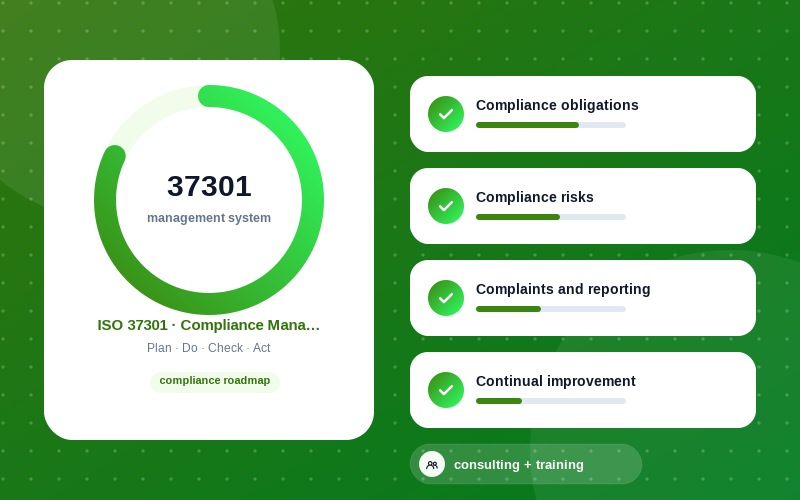
ISO 37301:2021

ISO 37301 consulting

Compliance management systems — Requirements and guidance for use

ISO 37301 consulting

What is ISO 37301?

Defines the requirements of a compliance management system that helps an organization manage its compliance obligations.

Purpose and scope

To systematically manage compliance with legislation and voluntary commitments and to develop a culture of compliance.

Who is it suitable for?

Organizations operating in regulated sectors and building a corporate compliance structure.

Required processes

  • Inventory of compliance obligations
  • Compliance risk assessment
  • Compliance control and monitoring
  • Reporting channels

Implementation stages

  1. Initial meeting and scope definition
  2. Current state (gap) analysis
  3. Implementation plan and role assignment
  4. Developing policies, processes and documents
  5. Implementation and employee training
  6. Internal audit and management review
  7. Support in preparing for the certification body's audit

Scope of consulting

  • Current state and gap analysis
  • System design and document preparation support
  • Employee awareness and implementation training
  • Internal audit support and corrective action tracking
  • Preparation for the certification audit (the certification decision does not rest with BDHA)

Training and implementation support

Awareness, implementation and internal auditor training for ISO 37301, together with implementation support throughout the process, is provided. Training and is not a consulting, certification or accreditation activity.

ISO 37301 consulting helps you build a compliance management system for your legal, regulatory and voluntary obligations. Deliverables: obligations register, risk assessment, policies and procedures, and certification readiness.

Inventory and prioritization of compliance obligations

In the first phase, the laws and regulations that apply to your organization, contractual commitments, sector rules and voluntarily adopted standards are collected in a single obligations register. For each obligation, a responsible unit, the related process and a monitoring frequency are defined. Compliance thus moves from scattered tracking to a documented, owned management topic.

Compliance risk assessment and controls

Each obligation is assessed for the likelihood and potential impact of a breach, and risks are mapped by process, unit and third party. Preventive and detective controls are designed for high-risk areas and the adequacy of existing controls is reviewed. The results are held in a risk register that feeds directly into management decisions on resources and priorities.

Culture, leadership and certification readiness

ISO 37301 is not just documents and procedures; the attitude of top management and the behavior of employees are part of the system. The engagement covers the compliance policy, roles and authorities, a training and awareness plan and a channel for raising concerns. BDHA does not issue certification; certification is carried out by authorized, accredited bodies, while BDHA provides consulting and preparation.

What is included?

  • Obligations register: collecting legislation, contracts and voluntary commitments with their responsible units in one record and defining how it is kept up to date.
  • Compliance risk analysis: scoring risks by likelihood and impact of a breach and setting the risk appetite together with management.
  • Policies and procedures: preparing the compliance policy, code of conduct and related process procedures to fit the structure of your organization.
  • Reporting and investigation: setting up a channel for raising concerns, a no-retaliation rule and a documented flow for handling reports.
  • Monitoring and internal audit: preparing compliance performance indicators, a periodic internal audit programme and the inputs for the management review meeting.

How we work

  1. Discovery

    Current-state analysis: applicable legislation, contracts and existing compliance practices are reviewed, interviews identify gaps and obligations without an owner, and scope and objectives are agreed in writing with management.

  2. Planning

    Planning and design: the obligations register and risk assessment are completed, the role and reporting line of the compliance function are defined, and drafts of policies and procedures plus a training plan are prepared for approval.

  3. Implementation

    Implementation and rollout: the approved policy, controls and reporting channel go live, relevant staff are trained, records start to be kept and first-period practice is monitored together on site.

  4. Support

    Internal audit and certification support: an internal audit and management review are carried out, corrective actions for nonconformities are closed, and the application file and audit-day preparation for the authorized certification body are supported.

What you gain

All obligations become visible in one register with their owners, so it is clear in advance who monitors each regulatory change and in which process.

Compliance risks are prioritized on evidence, controls and resources are directed to the areas of highest impact, and exposure to breaches and penalties can be reduced.

Compliance efforts can be demonstrated with records to management, stakeholders and auditors, resulting in a sustainable compliance management system that is ready for a certification audit.

Who is it for?

This service is for organizations in regulated sectors, with many legal and contractual obligations, or that want to institutionalize their compliance function. Finance, healthcare, energy, public-sector suppliers and exporters, as well as legal, risk, internal audit and quality managers, benefit directly from this work.

Frequently Asked Questions

What is the difference between ISO 37301 and ISO 9001?

ISO 9001 focuses on customer requirements and the quality of products or services, whereas ISO 37301 focuses on how an organization manages its legal, regulatory and voluntary compliance obligations. Both use a management system approach, so common structure and documentation elements can be shared. Many organizations run the two together in an integrated way.

Can a small organization implement ISO 37301?

Yes. The standard is written so that it can be scaled to the size, sector and compliance risks of the organization. In a small organization the register, risk assessment and procedures are kept leaner, but the policy, responsibilities, monitoring and improvement elements still have to be shown through records. We define the scope together, based on your actual risks.

Related services and resources

The edition and validity status must be verified against the official ISO/IEC catalogue and the national standards body before publication.

Quote & demo

Let's evaluate your project together.

Let's start with a short call about QISO demo, ISO consulting, Artificial intelligence feasibility or your custom software needs.

  • QISO demo
  • ISO consulting
  • Artificial intelligence
  • Custom Software