

IT Infrastructure Services

Database Performance | IT Infrastructure Services

We improve performance by analyzing slow queries and index structures.

Database Performance – image 1
Database Performance – image 2

We use measurement to find slow queries, missing or redundant indexes and resource bottlenecks, then remove what is slowing your application down. Deliverables include a prioritised findings list, tested improvements and a before-and-after comparison report.

Diagnosis that starts with measurement, not guesswork

Performance work begins by pinpointing which screen, report or transaction the complaint refers to. We then extract the queries that consume the most time, CPU and reads using Query Store, extended events and dynamic management views. This directs the effort at the ten or twenty queries that really create the load rather than at hunches, and makes the gain measurable.

Index design and query rewriting

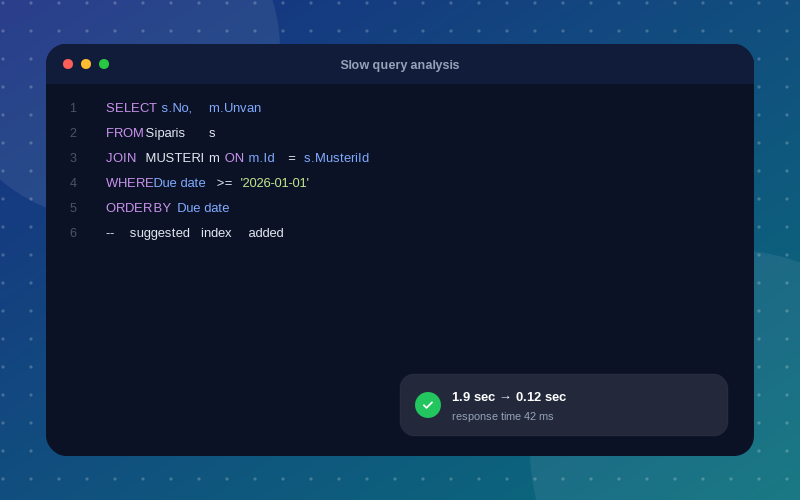
By examining execution plans, we identify table scans, key lookups, poor estimates and plan problems caused by parameter sniffing. Missing indexes are added, and unused or overlapping indexes are removed to cut write cost. Where needed, queries are rewritten more efficiently; changes that affect application code are assessed together with your development team and first in a test environment.

Wait statistics and hardware resources

When query tuning alone is not enough, we examine what the server is waiting for: disk latency, locking and blocking, memory pressure or CPU saturation. Wait types, counters and disk performance measurements are interpreted together. The result is turned into reasoned, cost-estimated recommendations such as memory settings, tempdb layout, storage placement or a capacity increase.

What is included?

  • Query analysis: The most expensive queries are ranked by duration, CPU and read count, and a cause and proposed fix is written for each.
  • Index inventory: Missing, unused, duplicate and fragmented indexes are identified, and proposals to add or remove them are presented with an impact analysis.
  • Deadlocks and blocking: Deadlock graphs and long-running transactions are examined, and corrective recommendations for isolation level and transaction design are prepared.
  • Resource configuration: Memory, MAXDOP, cost threshold and tempdb settings are reviewed against the workload and documented with their rationale.
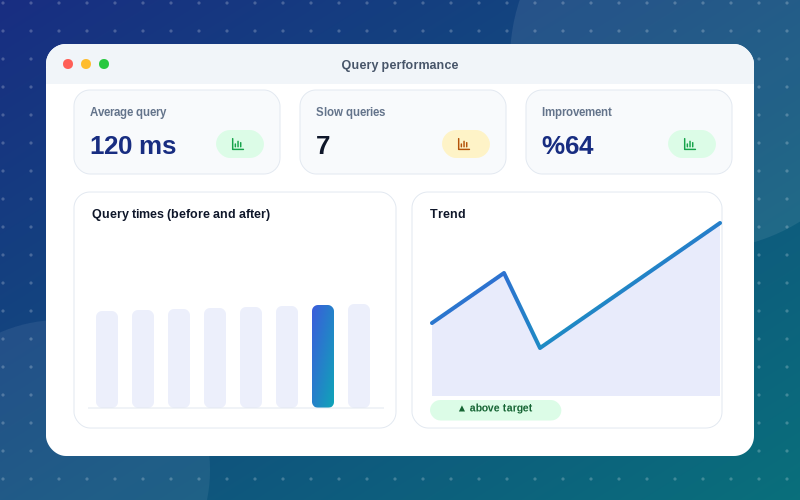
  • Comparison report: Measurements before and after the improvement are taken under the same conditions, and gains are reported together with a management summary.

How we work

  1. Discovery

    Together with users, we identify the screens and transactions that draw complaints, take baseline measurements during busy hours and clarify the success criteria for the improvement.

  2. Planning

    Using Query Store and execution plans, bottlenecks are classified, and each finding is ranked by impact, implementation cost and risk to form an improvement plan.

  3. Implementation

    Approved changes are first tried in a test environment and then applied to production one at a time; the effect of each is measured, and scripts are kept so it can be rolled back if necessary.

  4. Support

    Results are measured again and reported; query and index guidelines are handed over to the development team, and monitoring thresholds are defined to catch performance drift early.

What you gain

Response times of critical screens and reports shorten measurably, and user complaints are closed on the basis of before-and-after data rather than assumptions.

Server resources are used more efficiently, and hardware investment decisions are made knowing which part of the problem is caused by software and which by infrastructure.

Your team gains practical principles for query and index design, and new developments go live without recreating the same performance problems.

Who is it for?

This service suits organisations whose reports, screens or batch jobs slow down over time and where users complain of timeouts or freezes. Owners of ERP and production systems with growing data volumes, IT managers looking for common ground with a software vendor on where a problem comes from, and those who want an impartial technical assessment before investing in hardware will find it useful.

Frequently Asked Questions

Do we need to change the application code to improve performance?

Often not. Index adjustments, statistics and configuration settings can deliver gains without touching the application code. In some cases the query itself is the problem; we then pass the change on to your development team or vendor as a detailed recommendation and decide together on its implementation.

Can you tell us in advance how much improvement to expect?

We do not promise a fixed figure, as the gain depends on the source of the problem. At the end of the initial analysis we state the expected effect and the uncertainties for each finding. The actual gain is shown through before-and-after measurements taken under the same conditions, so your decisions rest on verifiable data rather than assumptions.

Related services and resources

Quote & demo

Let's evaluate your project together.

Let's start with a short call about QISO demo, ISO consulting, Artificial intelligence feasibility or your custom software needs.

  • QISO demo
  • ISO consulting
  • Artificial intelligence
  • Custom Software