

Integration Services

File-Based Data Transfer | Integration Services

We automate and audit file-based data exchange such as CSV and XML.

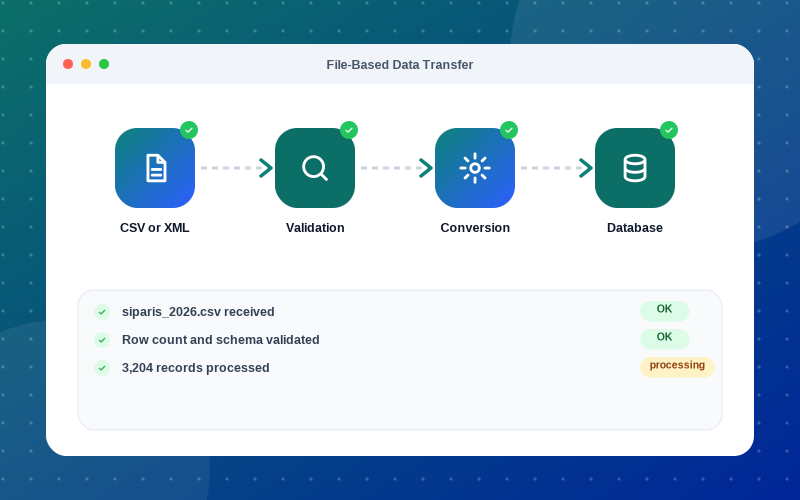
File-Based Data Transfer – image 1
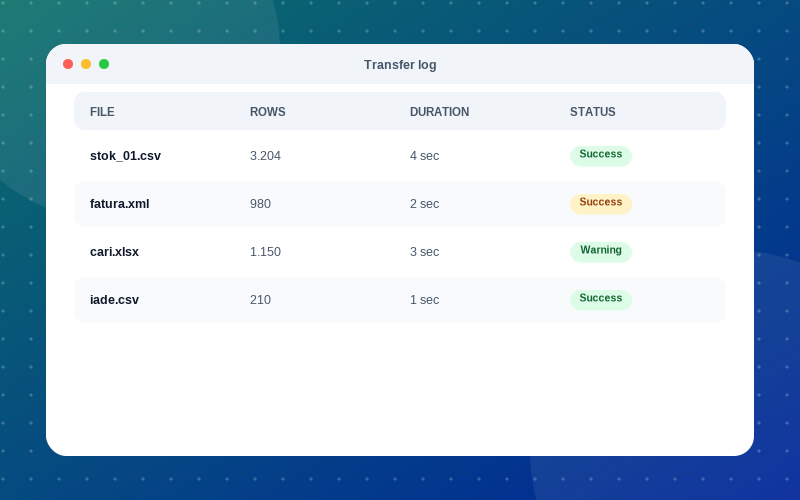
File-Based Data Transfer – image 2

We automate data exchange based on CSV, XML, Excel and fixed-width text files, delivering a scheduled transfer pipeline with secure transport, schema validation and faulty-record reporting in which every file can be traced.

Why files remain a common integration method

Banks, accounting packages, public portals and older production systems often offer no API; they deliver or expect data as a daily CSV or XML file. Moving these files around by email means errors and delay. Through folder watching, scheduled retrieval and automatic import we run the process without human intervention, yet in a traceable way.

Schema validation and faulty-record handling

A file should be tested structurally before it is imported. We validate XML against its XSD schema, and CSV by column count, encoding, delimiter, mandatory fields and date format. Invalid rows are quarantined and presented, with the reason, in an error report, while valid rows continue to be processed. One corrupt record therefore does not block the whole daily transfer.

Secure transfer and audit trail

Files often carry personal or financial data. We use encrypted transfer over SFTP, FTPS or HTTPS, key-based authentication and, where needed, PGP file encryption. The name, size, hash, arrival time and processing result of every file are recorded, and the same file cannot be processed twice. These records can serve as evidence in internal audits and incident reviews.

What is included?

  • Format analysis: File type, encoding, delimiter, field lengths and sample data are examined, and a format agreement is written for source and target.
  • Transfer channels: Automatic sending and receiving over SFTP, FTPS, network share or HTTPS is set up, with key-based authentication configured.
  • Schema validation: XSD, column, type and mandatory-field checks are carried out, and invalid files or rows are quarantined.
  • Faulty-record report: Rejected rows are collected in a report with reason and line number and forwarded automatically to the people concerned.
  • Audit trail and archive: File name, hash and result are recorded, and processed files are archived according to the retention rule.

How we work

  1. Discovery

    Discovery of file flows: In meetings with the teams involved we establish which system produces or expects which file and how often, who processes it by hand today, and where delays or errors occur.

  2. Planning

    Format and rule design: We put field mappings, validation rules, naming pattern, resend and correction behaviour in writing and submit the rules, with sample files, for the counterpart's approval.

  3. Implementation

    Development and testing: We write the import and export jobs, test edge cases such as an empty file, a missing column, double delivery and a very large file in separate scenarios, and compare the results against sample data.

  4. Support

    Go-live and monitoring: We switch on the schedules, set up an alert for a missing or late file, hand over the operations guide, and review the result of every file with you during the first weeks.

What you gain

Files carried by email attachment and uploaded by hand disappear; transfers take place on time and without human error.

Corrupt rows do not stop the whole transfer; because they are reported with reason and line number, they are quickly corrected at the source.

Because every file leaves a trace, internal audits, compliance checks and incident reviews can show who received what and when.

Who is it for?

This service suits businesses that receive account movements from banks, order or delivery-note files from suppliers, report periodically to public bodies, or obtain a daily file export from an older system. IT managers working with accounting, payroll, logistics and production teams, and operations units that still upload files by hand, are the main audience.

Frequently Asked Questions

Which file formats do you support?

We process CSV and delimited text, fixed-width files, XML, JSON, Excel workbooks and compressed packages such as ZIP. Encoding issues with Turkish characters and regional decimal separators need particular care, and we define them as rules. If a non-standard or proprietary format is involved, we write the parser from sample files.

What happens if the same file arrives twice or arrives late?

Because the name and hash of each file are recorded, the same content is not processed a second time; the system flags it as a duplicate and notifies you. A defined alert is sent for a file that does not arrive at the expected time, so the problem is noticed when it occurs rather than in end-of-day reports. A late file is taken into the normal flow without disturbing the sequence.

Related services and resources

Quote & demo

Let's evaluate your project together.

Let's start with a short call about QISO demo, ISO consulting, Artificial intelligence feasibility or your custom software needs.

  • QISO demo
  • ISO consulting
  • Artificial intelligence
  • Custom Software