

Integration Services

REST API Integrations | Integration Services

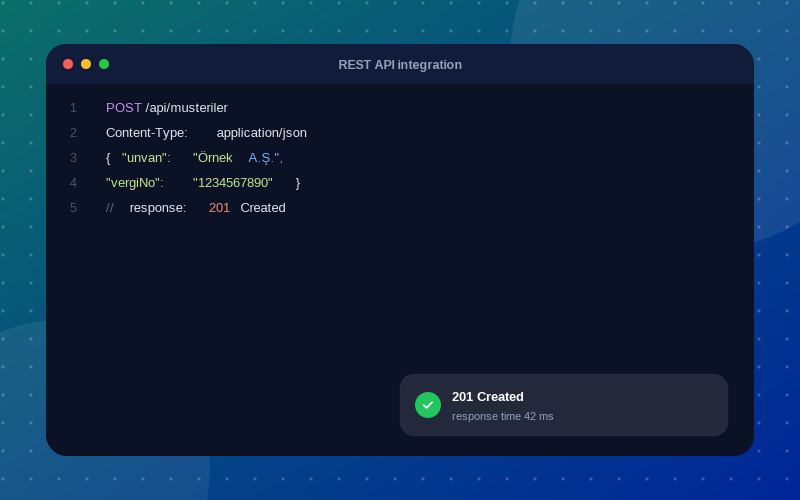
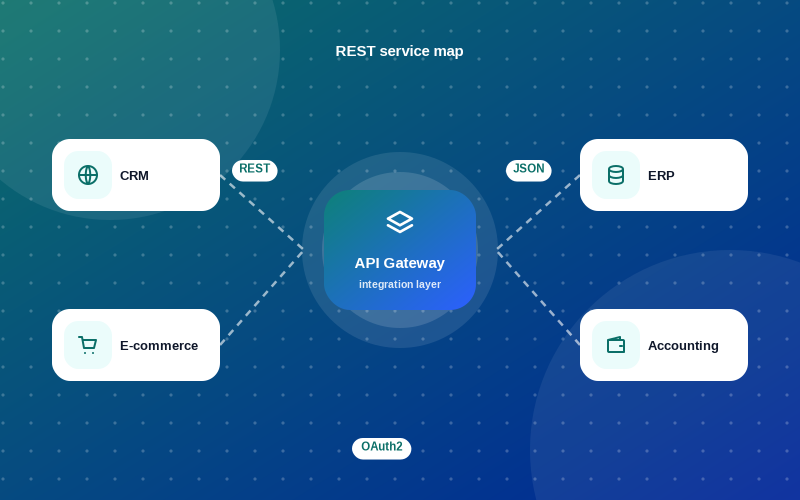
We develop and maintain JSON-based REST integrations with modern services.

REST API Integrations – image 1
REST API Integrations – image 2

We connect your business applications and third-party services through JSON-based REST interfaces, delivering working integration code with authentication, error handling and monitoring layers, plus operating documentation.

Why REST integration needs engineering discipline

Sending a REST call successfully is only the beginning. In production you meet network interruptions, expired tokens, version changes and partial responses. We design every integration with these cases in mind: idempotent requests, consistent error codes, structured logs and fallback scenarios that reduce the risk of data loss and duplicate records.

Authentication and security approach

Depending on the authorization model the service requires, we implement API keys, Basic, OAuth 2.0 client credentials or JWT-based flows. Token retrieval, caching and renewal before expiry are handled in one central layer, while secrets live in configuration and a secret store rather than in code. This keeps an audit trail and allows key rotation without downtime.

Staying stable under heavy traffic

External services usually apply rate limits and return large datasets in pages. Our integrations handle cursor or offset pagination correctly, respect the Retry-After header on 429 responses, retry with exponential backoff and use queues to smooth sudden peaks. The result complies with the provider's rules while keeping your own systems responsive under load.

What is included?

  • Source analysis: The counterpart's OpenAPI or Swagger document, endpoints, data models and versioning policy are reviewed and a field-mapping table is prepared.
  • Authentication: API key, OAuth 2.0 and JWT flows are set up, with token renewal and secret storage managed centrally.
  • Data transformation: JSON fields, date formats and currencies are converted to the target system's model and validated field by field.
  • Resilience: Pagination, rate limiting, timeouts and retry with exponential backoff protect the flow against transient failures.
  • Monitoring and alerting: Dashboards capturing request times, error rates and failed calls are set up together with threshold-based alerts.

How we work

  1. Discovery

    Discovery: We meet the owners of the applications involved, establish the direction, volume and frequency of the data flow, and assess the counterpart's API documentation and test-environment access together.

  2. Planning

    Design: Endpoint mapping, the authentication method, error and retry rules and any need for queuing are written up in an integration design and submitted for your approval.

  3. Implementation

    Development and testing: We build the integration layer, run unit tests against mock services and end-to-end scenarios against the real test environment, and test edge cases such as empty responses and dropped connections separately.

  4. Support

    Go-live and support: We move to production in stages, watch the logs closely in the early period, hand over an operations guide and provide maintenance support to adapt to the counterpart's version changes.

What you gain

Manual data entry and copying between systems disappear, and records reach the other side consistently and on time.

What happened during a failure can be traced in the logs, which shortens diagnosis and response and lowers the risk of lost or duplicate records.

With documented, version-controlled integration code your team can take over the service and adapt to provider changes in a controlled way.

Who is it for?

This service suits IT managers who want to connect several applications, organisations that need their ERP, CRM or quality systems to talk to cloud services, and businesses obliged to link a partner, supplier or public-sector REST interface to their own systems. Teams with limited in-house development capacity can run the integration externally with confidence.

Frequently Asked Questions

How long does a REST integration take?

The duration depends on the number of endpoints, the complexity of the data transformation, the quality of the counterpart's documentation and test-environment access. A simple one-way link and a multi-step two-way flow need very different effort. We clarify the scope during discovery and then share a written work plan and schedule.

Will the integration break if the other party changes its API?

Backward-compatible changes usually leave you unaffected, while breaking version changes require adjustment. To reduce this risk we use explicit version numbers, validate response schemas and raise warnings on unexpected fields. With a maintenance arrangement that tracks provider announcements, we carry out the adaptation in a planned way.

Related services and resources

Quote & demo

Let's evaluate your project together.

Let's start with a short call about QISO demo, ISO consulting, Artificial intelligence feasibility or your custom software needs.

  • QISO demo
  • ISO consulting
  • Artificial intelligence
  • Custom Software