

Integration Services

SAP Integration | Integration Services

We build integrations that securely share data from your SAP systems with other enterprise applications.

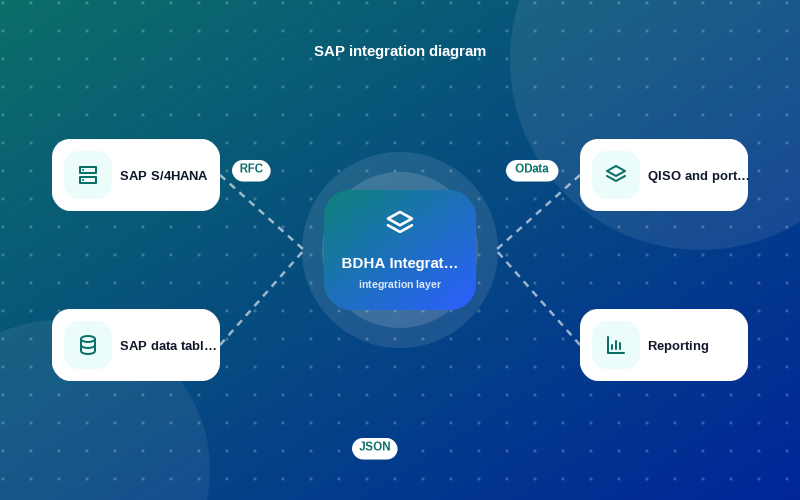
SAP Integration – image 1
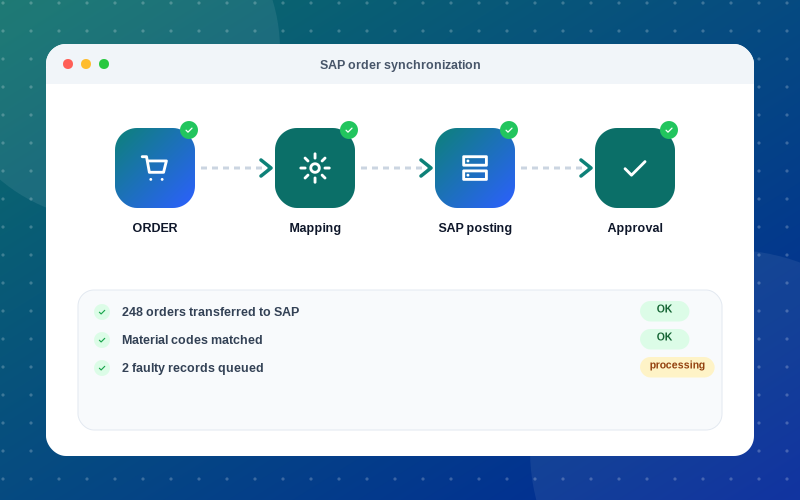
SAP Integration – image 2

We connect material, customer, order and accounting data in your SAP systems with quality, production and other business applications through traceable interfaces. Deliverables include an interface design document, a working integration, error handling and reconciliation reports.

Connecting SAP data to other applications the right way

In most organizations SAP is the single source of truth for finance, purchasing, inventory and production. When quality, supplier or service applications re-enter that data by hand, inconsistencies become unavoidable. In an integration project we decide which system owns which data, define each data flow by direction, and build a permanent connection that removes the need for duplicate entry.

Choosing the interface technology: IDoc, RFC, OData

On the SAP side, the same requirement can be met with different mechanisms. IDoc suits bulk, asynchronous document exchange, RFC or BAPI suits synchronous function calls, and OData or REST services suit modern web clients. We review your release, existing authorizations and data volume, then recommend the option with the lowest load and easiest maintenance, together with our reasoning.

Reconciliation, error handling and cutover safety

The value of an integration is measured by what happens when it breaks. We track the status of every message, queue failed records with their cause for reporting, and make them resendable once corrected. Periodic reconciliation reports compare record counts between SAP and the target system. For go-live, the test system, data samples and a rollback plan are prepared together.

What is included?

  • Master data transfer: Regular, controlled synchronization of master records such as materials, customers, suppliers and cost centers with the target applications.
  • Transaction data flow: Two-way, sequenced transfer of transactional documents such as purchase orders, goods receipts, production orders and quality notifications.
  • Interface layer selection: Evaluating IDoc, RFC, BAPI, OData and web service options against release and volume, and choosing one with documented reasoning.
  • Authorization and security: Designing least-privilege rights for the integration user, network access restrictions and secure storage of credentials.
  • Monitoring and reconciliation: Setting up message status tracking, a failed-record queue and periodic record-count comparison reports.

How we work

  1. Discovery

    We review the relevant SAP modules, release and processes, then clarify with you which data flows in which direction, how often and under whose ownership, and turn that into a written scope.

  2. Planning

    We prepare a design document with the field mapping table, transformation rules and interface technology, and plan access, network and test system needs with your SAP Basis and authorization teams.

  3. Implementation

    We build the integration in the test system and run it end to end with realistic data samples, verifying error scenarios, resending and volume load, and keeping the test results on record.

  4. Support

    We perform go-live in a planned window, review monitoring and reconciliation reports with you during the first period, and hand over an operations guide with the support and change process.

What you gain

Manual entry of the same data in several systems ends; records stay consistent between SAP and the target application, and data ownership becomes clear.

Errors no longer disappear silently; every failed transfer becomes visible with its cause, is corrected and resent, which shortens the time support teams spend hunting for problems.

You hold interface documentation, authorization records and reconciliation reports that support audits and internal control, and impact analysis becomes easier when systems change.

Who is it for?

This service suits organizations that run SAP and want to share finance, purchasing, inventory or production data with quality management, supplier portal, service or reporting applications. It is aimed at projects run jointly by IT, SAP consulting and process owner teams that want to get rid of manual data entry.

Frequently Asked Questions

Can an integration be built without adding custom development to our SAP system?

In many cases, yes. Standard IDoc message types, BAPI functions and published OData services cover most needs. Where standard interfaces fall short, we assess the smallest possible extension together with your SAP team. The decision is presented to you with reasoning after your release and authorization policies have been reviewed.

Will the integration affect the performance of our live SAP system?

Minimizing the impact is part of the design. High-volume transfers are scheduled for off-peak hours, change-based selective transfer is used and queries are limited. Volume tests are run in the test system; after go-live, load is monitored during the first period and scheduling is adjusted if needed.

Related services and resources

Quote & demo

Let's evaluate your project together.

Let's start with a short call about QISO demo, ISO consulting, Artificial intelligence feasibility or your custom software needs.

  • QISO demo
  • ISO consulting
  • Artificial intelligence
  • Custom Software