

Artificial Intelligence & Intelligent Business Processes

AI Integration into Existing Software | Artificial Intelligence & Intelligent Business Processes

We enrich your existing ERP, quality or business applications with AI capabilities without replacing them.

AI Integration into Existing Software – image 1
AI Integration into Existing Software – image 2

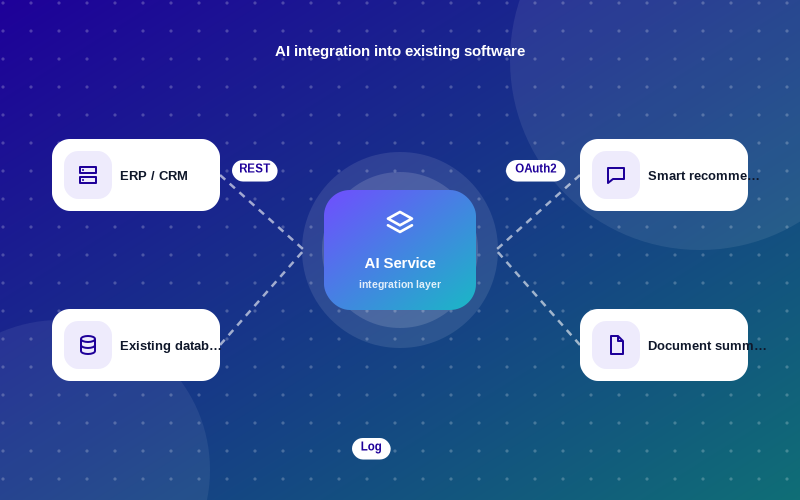
We add artificial intelligence capabilities to your existing ERP, quality management or business applications through an API layer, without replacing them. Deliverables are a working integration, a monitoring view and rollout documentation.

Adding capability without replacing software

Replacing an ERP or business application that has been in use for years is both costly and risky. In this service we place a separate artificial intelligence layer next to the existing software and let the two communicate. Capabilities such as summarisation, classification, anomaly alerts or natural-language queries become available without users leaving the screens they already know.

Fitting your data model and permissions

The quality of an integration depends on how well we understand the data model of the existing software. By reviewing tables, fields, code lists and business rules we define which data the artificial intelligence layer receives and in what form. Authorisation is preserved as well: a user who cannot see a record in their own application cannot see it through the AI either.

Phased rollout with a safe fallback

Instead of opening the artificial intelligence feature to every user at once, we start with a small pilot group. Output quality, response time and user feedback are monitored at this stage. Because the feature can be switched off, the existing software simply continues to work as before, with no changes required, should a problem arise.

What is included?

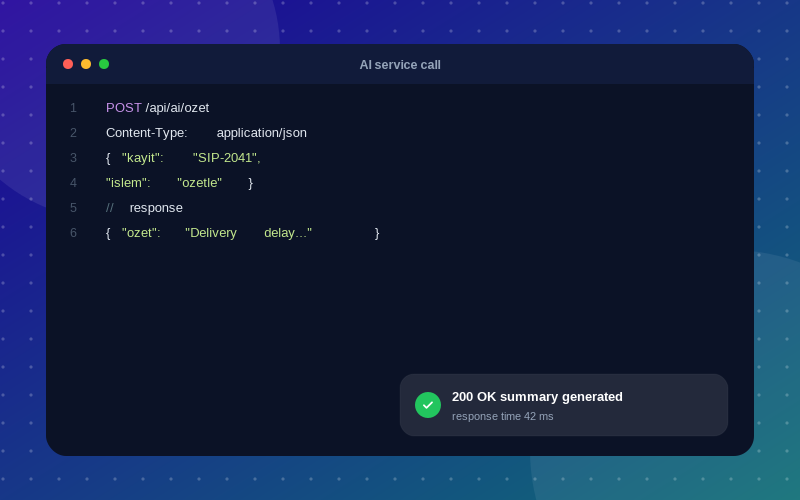
  • API design: We define the request and response contracts between the existing software and the artificial intelligence service, including authentication and error handling.
  • Data mapping: We build the mapping rules and cleansing steps that convert existing tables, fields and code lists into the format the artificial intelligence service expects.
  • User interface additions: We place the artificial intelligence output into the user's daily workflow by adding buttons, panels or suggestion areas to existing screens.
  • Security and permissions: We design data-sharing limits, role-based access and the masking of sensitive fields in line with the existing authorisation structure.
  • Monitoring and logging: We set up a monitoring view that records input, output and duration of every call and shows the error rate, then hand it over to operations.

How we work

  1. Discovery

    We examine the existing software, its database schema, interface points and usage habits, and work with users to identify the screens where artificial intelligence would genuinely reduce workload.

  2. Planning

    We document the integration architecture, data flow, permission boundaries and failure scenarios, and clarify which operations run synchronously, which run in the background and how the system behaves as a fallback.

  3. Implementation

    We develop the API layer and the interface additions and run them in a test environment with real data samples, checking output accuracy and response times against criteria agreed in advance.

  4. Support

    We go live first with pilot users, make adjustments based on their feedback and then open the feature to everyone else; afterwards we sustain operation with monitoring and maintenance support.

What you gain

Your software investment is protected: you start benefiting from artificial intelligence capabilities without retraining on a new system, migrating data or going through a long transition.

Users keep working from a single screen; because the artificial intelligence suggestions are embedded in the daily workflow, adoption stays easy and there is no extra tool to learn.

Because every call is logged, outputs are auditable, costs can be tracked and quality can be monitored; if problems occur, the feature can be switched off to return to the previous way of working.

Who is it for?

This service is for organisations that use an ERP, quality management, accounting or industry-specific software, do not want to abandon it, yet need capabilities such as document summarisation, recommendations, classification or natural-language queries. It suits IT managers, process owners and teams that wish to work together with their software vendor.

Frequently Asked Questions

Do you need access to the source code of our existing software?

In most cases, no. The API, web service, database view or file transfer points that the software already offers are usually sufficient. If such interfaces are missing or inadequate, we evaluate the least intrusive option together with you, taking vendor support and licence terms into account at that stage.

How is our data protected when it is sent to the artificial intelligence service?

We agree up front which fields are sent; unnecessary and personal data is masked or not transmitted at all. Communication runs over encrypted channels and access follows your existing permission structure. Whether the service runs on premises or in the cloud is chosen according to your data policy.

Related services and resources

Quote & demo

Let's evaluate your project together.

Let's start with a short call about QISO demo, ISO consulting, Artificial intelligence feasibility or your custom software needs.

  • QISO demo
  • ISO consulting
  • Artificial intelligence
  • Custom Software