

Artificial Intelligence & Intelligent Business Processes

AI-Powered Workflows | Artificial Intelligence & Intelligent Business Processes

We add AI-assisted decisions and content generation to the right steps of your workflows.

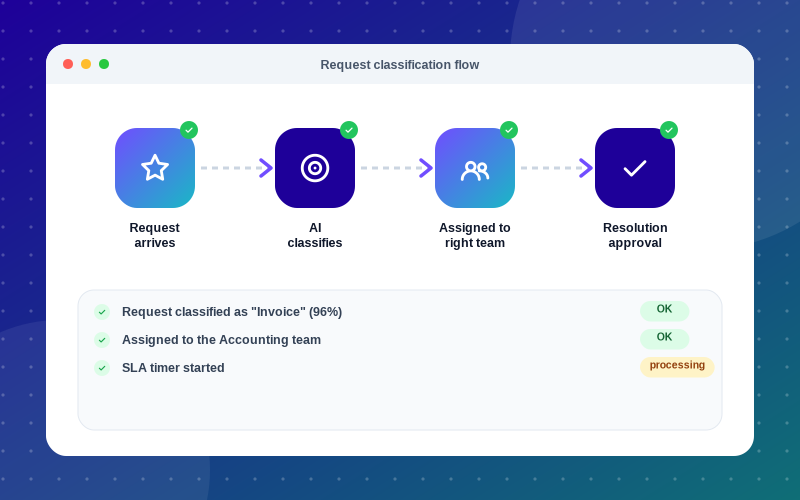
AI-Powered Workflows – image 1
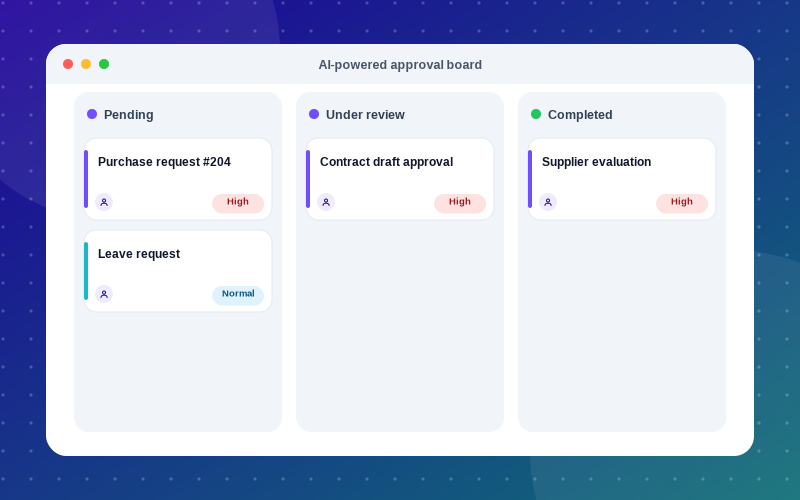
AI-Powered Workflows – image 2

We add artificial intelligence supported decision suggestions, summarisation and content generation to the right steps of your existing workflows, and design approval points that leave the final word to a person. Deliverables are the working workflow, a monitoring screen and a user guide.

Where artificial intelligence adds value and where it does not

Not every step of a workflow suits artificial intelligence. We first map the flow, mark waiting and repetition points, and single out language-based steps such as reading text, summarising, suggesting categories or drafting. Steps that can be solved with rules stay in classic automation, so cost, uncertainty and error risk increase only where truly needed.

Human-approved flows and accountability

Artificial intelligence output is a suggestion, not a decision. At important or irreversible steps we place approval points that present the output to an authorised person together with its reasoning; the person accepts, corrects or rejects the suggestion. Every decision is recorded with who made it, on what input and with which suggestion, preserving accountability and auditability.

Performance, error and cost monitoring

Once live, an artificial intelligence step is exposed to data and user behaviour that change over time. We set up a dashboard tracking how many suggestions are accepted, the correction rate, response time, error types and usage-driven cost. When quality drops, alerts are raised and prompts and rules are reviewed, so the workflow does not degrade unnoticed but is improved in a controlled way.

What is included?

  • Workflow analysis: We map the existing flow with its steps, roles, waiting and repetition points and identify steps suited to artificial intelligence, each with a measurable benefit hypothesis.
  • Decision and summarisation steps: We design steps that summarise texts such as requests, complaints or reports, suggest categories and priorities and prepare draft replies.
  • Approval points: We embed authority-based approval steps, at which suggestions are accepted, corrected or rejected, and decision records into your existing workflow tool.
  • Prompt and rule design: We write the prompts, examples and prohibited areas that define the format, tone and limits of the output, and keep them under version control.
  • Monitoring and improvement: We set up a dashboard tracking acceptance and correction rates, response time, error type and cost, and run an alert and review cycle when quality declines.

How we work

  1. Discovery

    We follow the chosen workflow step by step with its owners, measure waiting times and repeated manual tasks, and select a single step for adding artificial intelligence together with its success criterion.

  2. Planning

    For the chosen step we design input, output, approval point and error handling, and test prompts against real historical records to measure the quality of suggestions in advance.

  3. Implementation

    We connect the step to the existing workflow tool, add approval screens and logging fields, and run it with a small user group to collect the suggestion acceptance rate and feedback.

  4. Support

    Based on the measured results we make adjustments, open the workflow to all users and hand over the monitoring dashboard; we then start an improvement and support cycle for adding further steps.

What you gain

Repetitive reading, summarising and drafting tasks speed up, and employees can devote their time to work requiring judgement and decisions.

Decisions rest on consistent criteria and are recorded with their reasoning; responsibility stays with people while auditing and retrospective review become easier.

Because acceptance, correction and error indicators are tracked regularly, the real contribution of the artificial intelligence step is measured, and a step that does not help can be spotted and simplified or removed.

Who is it for?

This service is for operations, customer service, quality, human resources and purchasing teams that manage text-intensive processes such as requests, complaints, contracts, applications or reports. It suits organisations that want efficiency gains without replacing their existing workflow tool, yet give priority to keeping control and accountability with people.

Frequently Asked Questions

If artificial intelligence makes a decision, who is responsible in case of error?

In our design, artificial intelligence does not decide but produces suggestions; at important steps an authorised person approves or corrects them. For low-risk steps, automatic progression can be chosen, but this choice and its scope are defined by you in writing. All decisions and suggestions are kept on record.

Which workflows make sensible starting points?

Workflows that are text-heavy, high in volume and whose errors are reversible usually make good starting points, such as classifying incoming requests, summarising customer correspondence, pre-assessing complaints or preparing report drafts. We do not recommend starting with hard-to-reverse steps such as payment approval; experience is first gained on a low-risk step.

Related services and resources

Quote & demo

Let's evaluate your project together.

Let's start with a short call about QISO demo, ISO consulting, Artificial intelligence feasibility or your custom software needs.

  • QISO demo
  • ISO consulting
  • Artificial intelligence
  • Custom Software