

Custom Software & Enterprise Technology

Low-Code / No-Code Solutions | Custom Software & Enterprise Technology

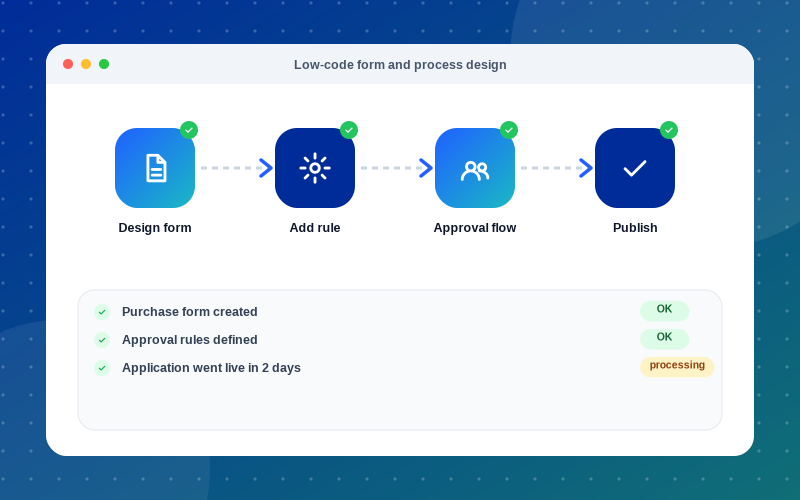
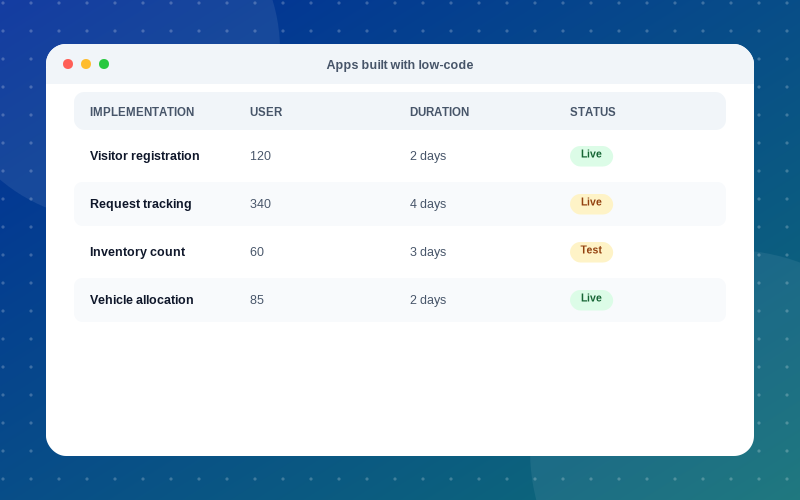
Where it fits, we recommend a low-code approach for applications that need to go live quickly.

Low-Code / No-Code Solutions – image 1
Low-Code / No-Code Solutions – image 2

For applications that need to go live quickly, BDHA recommends a low-code or no-code approach only where it genuinely fits. The deliverables are a suitability assessment, a working prototype or pilot application, and integration with your corporate data.

The right tool for the right job: suitability assessment

Not every application is a good fit for low-code platforms. We weigh process complexity, user numbers, data volume, security requirements and licence cost together. Simple approval flows, forms and internal reporting screens are often good candidates, while for systems needing heavy computation or a bespoke interface we openly recommend conventional development.

Rapid prototype and pilot application

For a process judged suitable, we build a working prototype quickly and run a pilot supervised with real users. The idea is tested through concrete screens and genuine workflows before full investment is made; fields, rules and roles are shaped by the feedback, making it clear whether the solution deserves to be scaled up.

Integration with corporate data and governance

When low-code applications stay isolated, they turn into new data silos. We therefore connect them to sources such as SQL Server, ERP or directory services and base authentication on your existing user structure. We also suggest a lightweight governance framework covering who may build applications, where data is kept and how changes are approved.

What is included?

  • Suitability analysis: Low-code, custom software or hybrid options are compared by process, user count, data sensitivity and licence cost.
  • Form and workflow applications: We build forms and multi-step flows for processes such as approvals, requests, applications and checklists.
  • Dashboards and reports: We prepare visual summaries and filterable reports for managers from existing data.
  • Data connections: We set up secure connections to SQL Server, Excel, REST services and directory services, and centralise authentication.
  • Governance and handover: Through a permission model, backups, version management and user training, we make the application sustainable inside your organisation.

How we work

  1. Discovery

    We examine the target process, the current way of working and where data is stored; the time savings low-code could bring are compared with its limitations in a suitability summary.

  2. Planning

    The platform and licence model are chosen, and a draft of user roles and the data model is produced; a working prototype built over days to weeks is then shown to stakeholders.

  3. Implementation

    The prototype goes into a pilot with a limited user group; usage observations and feedback are gathered, rules and screens are refined, and criteria are set for the decision to scale.

  4. Support

    The approved application is connected to corporate data sources, authorization and backups are set up; after user training and a handover document, an ongoing support and improvement process begins.

What you gain

Simple and moderately complex processes go into use faster than with conventional development, and the idea is tested before heavy investment is made.

Solutions with lower licence or maintenance cost are selected, and for unsuitable work conventional development is recommended from the start, avoiding a wrong platform investment.

Applications work integrated with your existing user structure and data sources, which prevents data silos and uncontrolled shadow-IT applications from emerging.

Who is it for?

This service suits organisations seeking quick departmental solutions without neglecting IT governance and data security. Business unit managers who want to digitise processes run on spreadsheets, IT directors with limited software team capacity, and product owners who want to try an idea before committing investment benefit from it.

Frequently Asked Questions

Do low-code solutions meet enterprise security requirements?

That depends on the chosen platform and how it is configured. We evaluate topics such as authentication, role-based permissions, data location and backup during the selection stage. If a security or compliance requirement goes beyond what the platform offers, we say plainly that developing that process as custom software is more appropriate.

Can the application later be turned into custom software after the prototype?

Yes, and this is often part of a deliberate roadmap. The prototype and pilot clarify requirements and user behaviour, and the data model and business rules are documented. If the application grows or hits the platform's limits, this knowledge carries over into custom development, so the analysis work is not wasted and the transition is more controlled.

Related services and resources

Quote & demo

Let's evaluate your project together.

Let's start with a short call about QISO demo, ISO consulting, Artificial intelligence feasibility or your custom software needs.

  • QISO demo
  • ISO consulting
  • Artificial intelligence
  • Custom Software