

Custom Software & Enterprise Technology

MRP & Production Planning | Custom Software & Enterprise Technology

We make production orders, material requirements and capacity planning traceable in a digital environment.

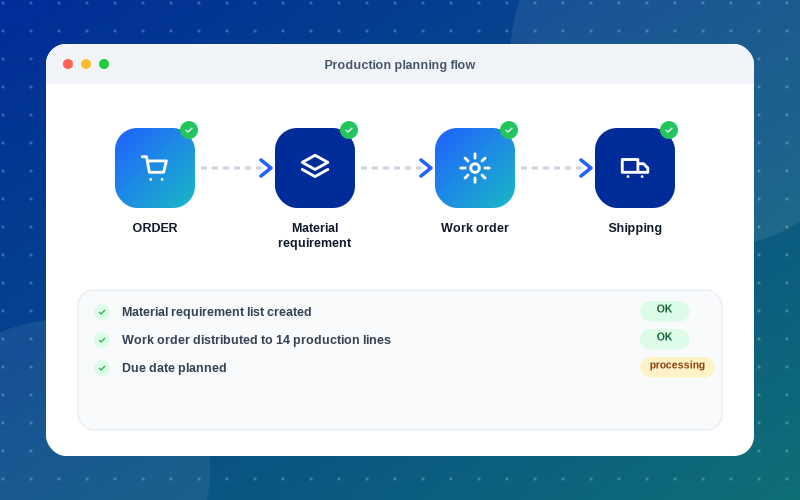
MRP and Production Planning – image 1
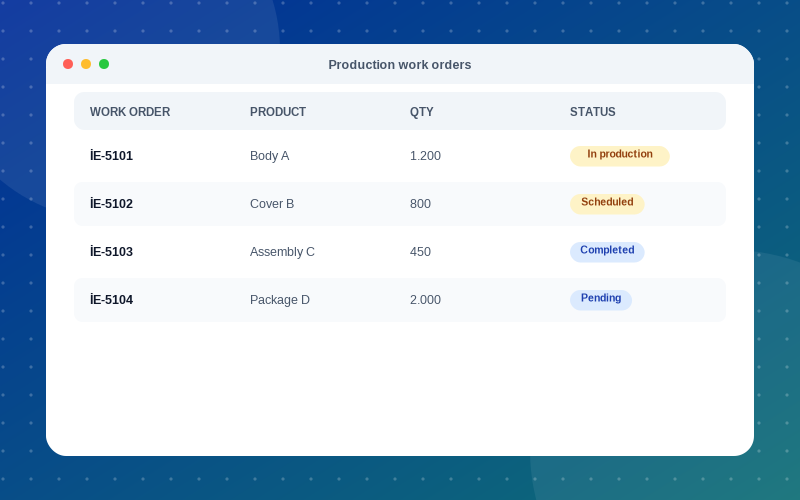
MRP and Production Planning – image 2

We develop MRP applications that make your production flow traceable digitally, from bill of materials to work order and from material requirements calculation to capacity plan. Deliverables are a working system, bill of materials migration and shop-floor user training.

Bill of materials and material requirements calculation

A multi-level bill of materials defines finished goods, semi-finished goods and raw materials with their quantities, scrap rates and alternative components. Once orders and forecasts are entered, the system nets on-hand stock, open purchase orders and work in progress against gross requirements to obtain net requirements. When and how much to order then rests on calculation rather than guesswork.

Work orders, routings and shop-floor tracking

Planned production is converted into work orders along the stations of a routing. Operators start and stop jobs and enter good and defective quantities on a tablet or terminal, and downtime reasons are recorded by code. Managers see in real time which order is waiting at which station and which job is at risk of delay, reducing dependence on paper job sheets.

Linking stock, procurement and capacity

Once material needs are determined, the system proposes purchase requisitions shaped by lead times, minimum order quantities and supplier data. Material consumed in production is deducted from stock automatically, and lot and serial traceability is maintained. A finite-capacity view shows machine and shift loads, and for overloaded stations the options of rescheduling or subcontracting can be assessed.

What is included?

  • Bill of materials management: multi-level structures, revisions, alternative components, scrap rates and validity date definitions.
  • Material requirements planning: gross-to-net calculation, lead-time offsetting and generation of purchase or production proposals.
  • Work orders and routings: operation sequence, station assignment, start-stop logging, scrap and downtime reason entry.
  • Capacity planning: machine, shift and staff load, bottleneck view and rescheduling simulation.
  • Stock and traceability: consumption posting, finished-goods receipt, lot and serial tracking and data flow with accounting or ERP.

How we work

  1. Discovery

    We walk the shop floor and record how planning is currently done and what is tracked on paper or in Excel. Product groups, routings and bottleneck stations are identified, and the project scope is put in writing.

  2. Planning

    We check the data quality of the bills of materials and have missing units and scrap data completed. Planning parameters, safety stock and lead times are set up with the users, and screen and output samples are approved.

  3. Implementation

    We first run a pilot on a single product group or line and compare planned with actual production. After deviations are resolved, the remaining lines and the ERP or accounting connections are brought into operation.

  4. Support

    We train workshop users on site, keeping operator screens simple. In live use, parameter settings are reviewed together during the maintenance period based on delay, stock variance and downtime reports.

What you gain

Material shortages are visible before production starts, reducing emergency purchases and unplanned line stoppages.

The status, cost and consumed lots of every work order are on record, allowing quick answers to customer queries and internal audits.

Planning moves away from knowledge held by individuals, and delivery date commitments are given on the basis of capacity and stock data.

Who is it for?

Suited to manufacturers producing to order or in series, in sectors such as metal, plastics, machinery, furniture, textiles or food, that manage bills of materials, work orders and stock on Excel and paper. It helps most when planning, purchasing, warehouse and shop-floor managers want to work from shared data.

Frequently Asked Questions

Are MRP and ERP the same thing, and do I need both?

MRP focuses on material and production planning, whereas ERP is a broader structure that also covers finance, purchasing, sales and human resources. Setting up production planning as a separate application lets you begin without replacing your existing accounting software. If you wish, we can integrate it with an ERP later.

Is it also suitable for a small workshop, and how many users are needed?

Yes; the scope can be narrowed to the size of the company. A small workshop starts with just the bill of materials, work orders and stock deduction, leaving capacity planning and quality records for a later phase. The number of users depends on who will use the planner, warehouse and shop-floor screens; there is no fixed minimum.

Related services and resources

Quote & demo

Let's evaluate your project together.

Let's start with a short call about QISO demo, ISO consulting, Artificial intelligence feasibility or your custom software needs.

  • QISO demo
  • ISO consulting
  • Artificial intelligence
  • Custom Software