

Custom Software & Enterprise Technology

Custom Integrations | Custom Software & Enterprise Technology

We develop custom integration layers for systems that have no ready-made connector.

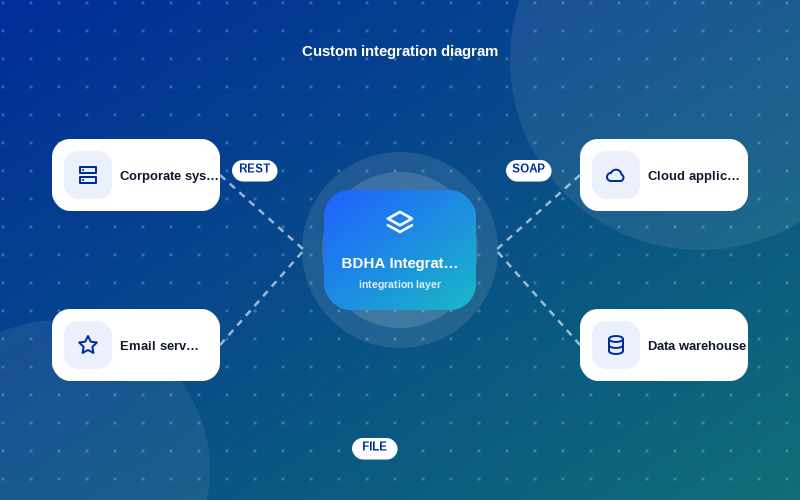
Custom Integrations – image 1
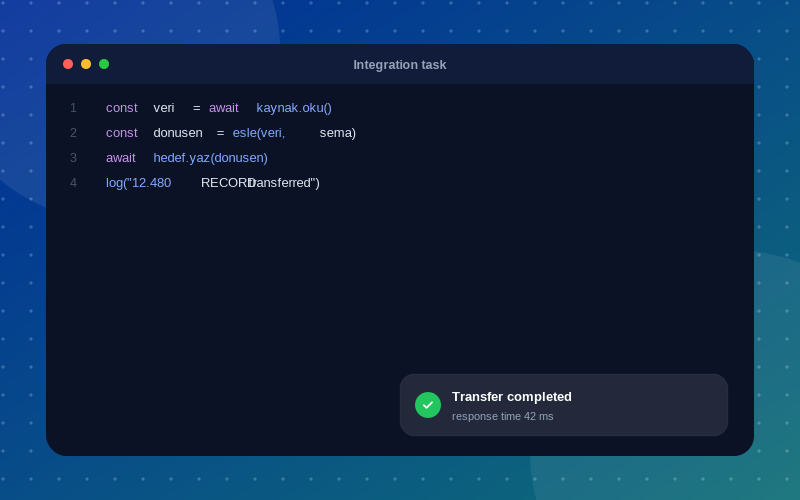
Custom Integrations – image 2

BDHA develops custom integration layers that move data between systems for which no ready-made connector exists. The deliverables include a data mapping specification, a working integration service, error and retry handling, and a monitoring dashboard.

What to do when no ready-made connector exists

For an old inventory program, an industry-specific device software or a partner's closed system, the market may offer no ready connector. In that case we examine the interfaces that are accessible and connect the systems by choosing the safest, easiest-to-maintain method, such as a database, files, a web service or a message queue.

Data mapping, transformation and validation

The real difficulty of most integrations is that systems give the same concept different names, formats and codes. We document field mappings, code tables, date and currency conversions together with you, and filter out missing or faulty records at intake with validation rules. Reconciliation reports show that data stays consistent on both sides.

Error handling, retries and traceability

Integrations fail from time to time because of network outages, counterpart maintenance or faulty data. Anticipating this from the start, we design a retry policy, identifier logic that prevents duplicate processing, and a separate queue for messages that cannot be processed. Detailed logs and alerts make visible where and when a problem occurred.

What is included?

  • Interface discovery: We examine the counterpart system's database, file, service or device interfaces and recommend the most suitable connection method with reasons.
  • Data mapping: Field equivalents, code tables, unit and format conversions are kept in a mapping document and submitted for approval by both sides.
  • Resilient messaging: We apply queue-based or scheduled processing, retries and identifier checks that prevent duplicate transactions.
  • Security: Connection credentials are stored safely, and data exchange is protected with encrypted communication, the principle of least privilege and access records.
  • Monitoring and documentation: A dashboard showing successful and failed flows, alert rules and an operations manual are delivered.

How we work

  1. Discovery

    We determine the systems to integrate, the direction and frequency of data and the business rules; accessible interfaces are examined, and the scope, assumptions and acceptance criteria of the integration are written down.

  2. Planning

    The architecture and data mapping document is prepared; error scenarios, retry rules and monitoring requirements are defined and reviewed with the technical owners on both sides.

  3. Implementation

    The integration service is developed and tried in a test environment with realistic data; edge cases, large volumes and connection drops are turned into scenarios and verified with reconciliation reports.

  4. Support

    At go-live the service is installed and monitoring and alerts are activated; the data flow is followed closely in the first period, after which support, change requests and maintenance are carried out.

What you gain

Manual data entry and file shuffling between disconnected systems decrease, and data is available in the right place consistently and on time.

Failed transfers do not disappear; error queues and alerts make problems actionable, and records are verified through reconciliation.

The integration becomes documented, traceable and transferable; when one system changes, the effort needed to re-establish the connection stays predictable.

Who is it for?

This service suits organisations that must use old and new systems together although they do not talk to each other. IT managers who move data between different software in areas such as production, warehousing, finance or human resources, integration owners, and operations teams wanting automated data exchange with partners benefit from it.

Frequently Asked Questions

Is integration still possible if the counterpart system has no interface at all?

Often yes. Even with systems that offer no direct service, data can be obtained through exported files, database access or scheduled reports. The method depends on the limits and support terms set by the counterpart system's vendor, so we first clarify which option is technically and contractually acceptable.

Is data lost if a system goes down during an integration?

Preventing this is a core design goal. Records that cannot be processed are held in a queue or error table and retried under a defined policy when the connection returns. Record identifiers ensure that the same transaction is not applied twice. Reconciliation reports also compare record counts and amounts in both systems so that missing transfers are detected.

Related services and resources

Quote & demo

Let's evaluate your project together.

Let's start with a short call about QISO demo, ISO consulting, Artificial intelligence feasibility or your custom software needs.

  • QISO demo
  • ISO consulting
  • Artificial intelligence
  • Custom Software