

ISO 10002:2018

ISO 10002 consulting

Quality Management — Customer satisfaction — Guidelines for complaints handling in organizations

ISO 10002 consulting

What is ISO 10002?

Provides guidelines for handling customer complaints effectively and fairly.

Purpose and scope

To increase customer trust and satisfaction by systematizing complaint management.

Who is it suitable for?

Manufacturing and service organizations with intensive customer relationships.

Required processes

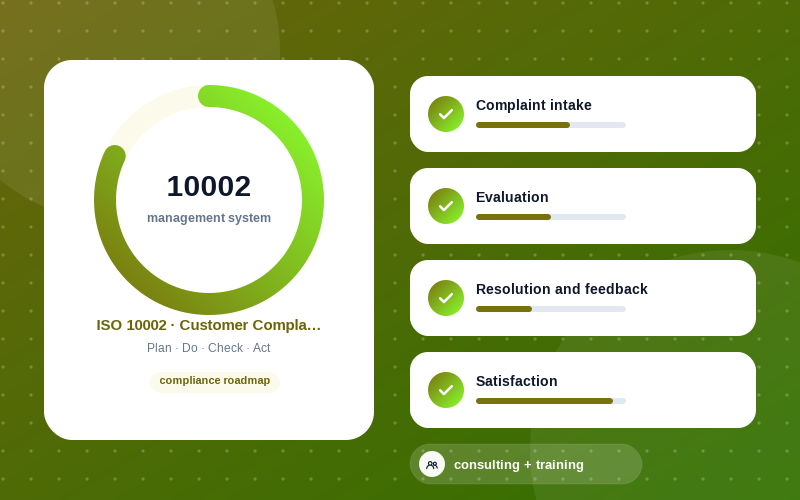
  • Complaint intake and classification
  • Resolution and feedback
  • Complaint analysis
  • Continual improvement

Implementation stages

  1. Initial meeting and scope definition
  2. Current state (gap) analysis
  3. Implementation plan and role assignment
  4. Developing policies, processes and documents
  5. Implementation and employee training
  6. Internal audit and management review
  7. Support in preparing for the certification body's audit

Scope of consulting

  • Current state and gap analysis
  • System design and document preparation support
  • Employee awareness and implementation training
  • Internal audit support and corrective action tracking
  • Preparation for the certification audit (the certification decision does not rest with BDHA)

Training and implementation support

Awareness, implementation and internal auditor training for ISO 10002, together with implementation support throughout the process, is provided. Training and is not a consulting, certification or accreditation activity.

ISO 10002 consulting ensures that customer complaints are managed through a fair, transparent and traceable process, from logging to closure. Deliverables include a complaints policy, process flow, classification rules and reporting indicators.

Designing the complaints process

The foundation of the work is to gather complaints into a single flow regardless of the channel they arrive through, to acknowledge receipt to the customer, to assign an owner and to define response times. Channels such as telephone, e-mail, web form and social media are mapped, and responsibilities, record fields and rules for communicating with the customer are set for each step.

Classification, analysis and resolution

Complaints are classified by subject, severity and area of impact, and simple requests are handled through a different path from recurring complaints or those with a safety effect. Where root cause analysis calls for it, corrective and preventive action is started, the resolution is communicated to the customer with its reasoning, and the customer's satisfaction with the outcome is recorded.

Nature of the standard and certification

ISO 10002 is a guidance document; because it is not a requirements standard, it is generally not the subject of certification and organisations apply it within a management system such as ISO 9001. BDHA does not issue certificates; certification is performed by authorised and accredited bodies. BDHA adapts the guidance principles to the organisation's existing system and builds a practice that can be demonstrated in audits.

What is included?

  • Complaints policy: the principles for complaints, the organisation's commitment, the customer's rights and how complaints can be submitted are published in a short, clear text.
  • Channel and record structure: all intake channels are linked to a single record model, with mandatory fields, priority codes and related order or product information defined.
  • Response times and escalation: acknowledgement, first response and resolution times by complaint type, and rules for escalating to a higher level, are determined.
  • Analysis and improvement: complaint data is analysed by subject, product, region and channel, and corrective action proposals are produced for recurring causes.
  • Confidentiality and personal data: protection of the complainant's information, access rights and retention periods are arranged in line with data protection obligations.

How we work

  1. Discovery

    Current state analysis: how complaints arrive today, who handles them and how long they take to close is examined, and weak points are identified from the existing records.

  2. Planning

    Process design: the complaint flow, roles and responsibilities, classification codes and response times are documented in a design that takes the customer experience into account and are approved together with the units concerned.

  3. Implementation

    Implementation and training: customer representatives and relevant managers are trained with real case examples, the complaint logging tool is put into operation and the process is closely monitored and adjusted in the initial period.

  4. Support

    Measurement and review: complaint volumes, closure times and customer satisfaction indicators are reported, used in management review and the process is improved at regular intervals.

What you gain

Customers know how and when their complaints will be answered, and lost, late or ownerless complaints are prevented.

Complaint data makes recurring problems visible, so product, service and process improvements rest on recorded evidence rather than guesswork.

Complaints management complements ISO 9001 customer satisfaction practices, and audits can show that customer feedback is handled systematically.

Who is it for?

Suitable for manufacturing, retail, finance, telecommunications, healthcare and service organisations with customer service, after-sales support and quality units. Customer experience, quality and operations managers benefit, as do teams that want to manage customer feedback more strongly within an ISO 9001 system and aim to turn complaints into a source of organisational learning.

Frequently Asked Questions

Can certification be obtained for ISO 10002?

ISO 10002 contains guidance rather than requirements, so it is not designed for certification. Organisations usually apply it within a certifiable management system such as ISO 9001, and complaints management is assessed in the audit of that system. BDHA sets up the process in line with the guidance and prepares records that can be shown at the audit.

Does a small business need a formal complaints system?

As the scale gets smaller the system gets leaner, but the principles of recording a complaint, assigning it to someone, answering it and closing it remain valid. In small businesses a single record list, a named owner and a simple response-time rule are often enough; as the business grows, the process can move to a software-supported structure.

Related services and resources

The edition and validity status must be verified against the official ISO/IEC catalogue and the national standards body before publication.

Quote & demo

Let's evaluate your project together.

Let's start with a short call about QISO demo, ISO consulting, Artificial intelligence feasibility or your custom software needs.

  • QISO demo
  • ISO consulting
  • Artificial intelligence
  • Custom Software