

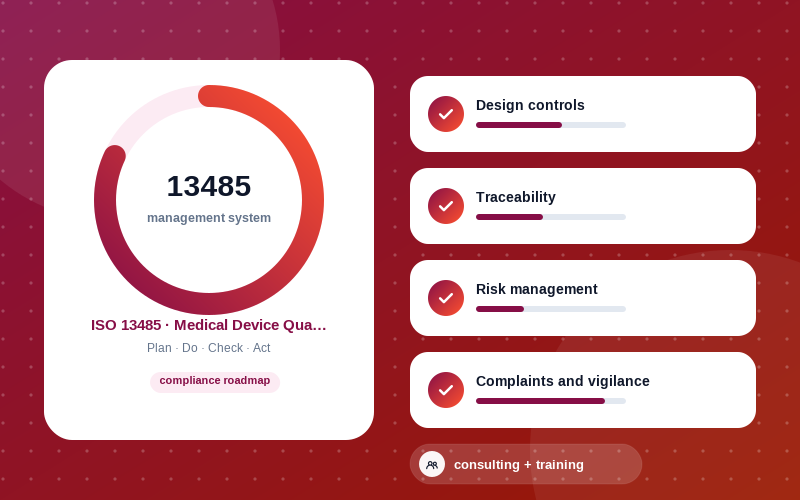
ISO 13485:2016

ISO 13485 consulting

Medical devices — Quality management systems — Requirements for regulatory purposes

ISO 13485 consulting

What is ISO 13485?

The standard that sets out the requirements for a quality management system and regulatory compliance across the medical device lifecycle.

Purpose and scope

Supporting the consistent manufacture of safe and effective medical devices and regulatory compliance.

Who is it suitable for?

Medical device manufacturers, suppliers and distributors.

Required processes

  • Design and development controls
  • Risk management
  • Traceability
  • Complaint and vigilance processes
  • Verification and validation

Implementation stages

  1. Initial meeting and scope definition
  2. Current state (gap) analysis
  3. Implementation plan and role assignment
  4. Developing policies, processes and documents
  5. Implementation and employee training
  6. Internal audit and management review
  7. Support in preparing for the certification body's audit

Scope of consulting

  • Current state and gap analysis
  • System design and document preparation support
  • Employee awareness and implementation training
  • Internal audit support and corrective action tracking
  • Preparation for the certification audit (the certification decision does not rest with BDHA)

Training and implementation support

Awareness, implementation and internal auditor training for ISO 13485, together with implementation support throughout the process, is provided. Training and is not a consulting, certification or accreditation activity.

ISO 13485 consulting builds a medical device quality management system: design and development controls, risk management, traceability, production and sterilization controls and records aligned with regulatory requirements are prepared.

Design file and risk management

Design and development controls sit at the heart of the medical device lifecycle. Planning, inputs, outputs, review, verification, validation and change records are gathered per device in a design file. Risk management is integrated with this file: hazards are identified, risks evaluated, control measures tracked and post-production feedback used to update the risk assessment.

Production, traceability and validated processes

In production and service delivery, cleanliness, contamination control, batch and serial-number traceability and device records (the device master record) are organized. Processes whose output cannot be fully verified afterwards, such as sterilization, welding or packaging sealing, are brought under control through validation protocols. Supplier selection, software validation and measuring equipment calibration are planned within the same framework.

Certification and the limits of our role

BDHA does not issue certificates; certification is carried out by authorized, accredited certification bodies. BDHA provides consulting and preparation: the quality manual, procedures and records, internal audit and management review fall within this scope. Product registration, CE marking and notified body procedures are separate regulatory obligations, and no automatic approval is promised as an outcome of this work.

What is included?

  • Quality manual and document control: The quality policy, medical device files and record control are set up, with retention periods defined according to device lifetime.
  • Design and development controls: Input, output, review, verification and validation steps are planned and recorded per device.
  • Risk management: Hazard analysis, risk control measures and acceptance of residual risks are updated throughout the lifecycle and linked to the design file.
  • Production, traceability and validation: Batch records, clean room or environmental conditions and validation of special processes such as sterilization and packaging are carried out.
  • Post-market surveillance and corrective actions: Customer complaints, safety reporting, the recall process and CAPA records are arranged.

How we work

  1. Discovery

    The product family, target markets, device class, applicable regulations and existing quality practices are reviewed; a gap analysis is carried out and scope and justified exclusions are defined.

  2. Planning

    The quality manual, procedures, design file templates and risk management file are prepared; responsibilities, competence requirements and infrastructure and work environment needs are defined.

  3. Implementation

    Procedures are applied on the shop floor; production, verification and validation work is carried out, suppliers are evaluated and the team is trained in traceability and record keeping.

  4. Support

    The internal audit and management review are completed, CAPA records are closed, a readiness review is held before the certification audit and consulting support is offered during the audit.

What you gain

The lifecycle from design to post-market surveillance becomes traceable through records, and device-based files are gathered in one place.

Risks, complaints and corrective actions are handled within a single system, and in a possible recall it can be quickly determined which batch is where.

You obtain a quality management system ready for regulatory and customer audits and suited to the certification process, together with the records that evidence it.

Who is it for?

Suited to organizations that manufacture, design, distribute or service medical devices, in vitro diagnostic products, orthopedic and surgical supplies, single-use consumables, dental products or device components. It addresses quality, regulatory and production teams and managers who want to build a recorded and validated system.

Frequently Asked Questions

How does ISO 13485 differ from ISO 9001?

ISO 13485 focuses on regulatory compliance and product safety rather than customer satisfaction and continual improvement. It contains more detailed requirements for documentation, design files, risk management, traceability, validation and post-market monitoring. Although the two standards can be built together, ISO 13485 expects stricter records and controls.

Is an ISO 13485 certificate enough for CE marking?

No. ISO 13485 is a foundation for the quality management system and supports a significant part of the system requirements regulations ask for; however, a technical file, clinical evaluation, notified body review depending on device class and product registration are required separately. Consulting clarifies which documents relate to these obligations.

Related services and resources

The edition and validity status must be verified against the official ISO/IEC catalogue and the national standards body before publication.

Quote & demo

Let's evaluate your project together.

Let's start with a short call about QISO demo, ISO consulting, Artificial intelligence feasibility or your custom software needs.

  • QISO demo
  • ISO consulting
  • Artificial intelligence
  • Custom Software