

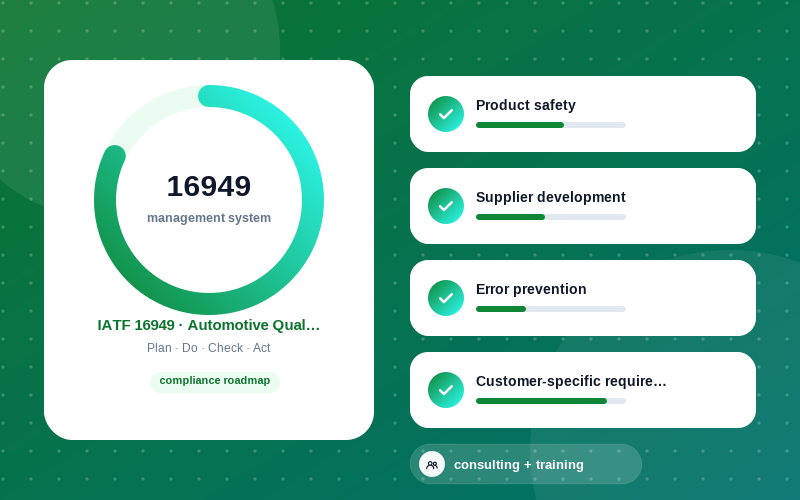
IATF 16949:2016

ISO 16949 (IATF 16949) consulting

Automotive quality management systems — IATF 16949 (replaces ISO/TS 16949)

ISO 16949 (IATF 16949) consulting

What is ISO 16949 (IATF 16949)?

In the automotive supply chain ISO 9001a quality management system requirement that adds sector-specific requirements on top of it. Formerly known as ISO/TS 16949, it has been replaced by IATF 16949:2016.

Purpose and scope

Ensuring consistent quality in the automotive supply chain through defect prevention and reduced variation and waste.

Who is it suitable for?

Automotive OEM and tier supplier manufacturers.

Required processes

  • Control plan, PFMEA and MSA
  • APQP and PPAP
  • Statistical process control
  • Management of customer-specific requirements

Implementation stages

  1. Initial meeting and scope definition
  2. Current state (gap) analysis
  3. Implementation plan and role assignment
  4. Developing policies, processes and documents
  5. Implementation and employee training
  6. Internal audit and management review
  7. Support in preparing for the certification body's audit

Scope of consulting

  • Current state and gap analysis
  • System design and document preparation support
  • Employee awareness and implementation training
  • Internal audit support and corrective action tracking
  • Preparation for the certification audit (the certification decision does not rest with BDHA)

Training and implementation support

Awareness, implementation and internal auditor training for ISO 16949 (IATF 16949), together with implementation support throughout the process, is provided. Training and is not a consulting, certification or accreditation activity.

IATF 16949 (formerly ISO/TS 16949) consulting helps you build a quality management system meeting the automotive requirements added to ISO 9001. Deliverables: APQP, PPAP, FMEA, control plan, MSA, SPC and certification readiness.

Automotive requirements built on top of ISO 9001

IATF 16949 is based on the ISO 9001 structure and adds requirements specific to the automotive industry. Product safety, error-proofing, management of special characteristics, supplier development, customer-specific requirements and analysis of field failures come first among them. The consulting compares your existing ISO 9001 system against these additional expectations and lists the gaps. IATF 16949:2016 replaced ISO/TS 16949.

Core tools: APQP, PPAP, FMEA, MSA and SPC

The core tools are the practical backbone of automotive quality. In new product development, the APQP plan and phase gates, design and process FMEA, the control plan, measurement system analysis and statistical process control are set up as one connected chain. The production part approval file is prepared at the level the customer requires. The aim is that these tools are actually used on the shop floor and not only kept in a file.

Customer-specific requirements and certification

Each large OEM adds its own customer-specific requirements to IATF 16949, which can change expectations for internal audits, reporting and approvals. In this work those requirements are mapped to your system and built into the relevant procedures. BDHA does not issue certification; IATF 16949 certification is carried out by certification bodies authorized by IATF, while BDHA provides consulting and preparation.

What is included?

  • Gap analysis: comparing the existing ISO 9001 system against IATF 16949 clauses and customer-specific requirements, with a prioritized action list.
  • APQP and PPAP: setting up new product development phases, phase gates and the production part approval file.
  • FMEA and control plan: assessing design and process risks with an RPN or action priority method and linking them to the control plan.
  • MSA and SPC: measurement system repeatability and reproducibility studies, process capability and control chart applications.
  • Suppliers and internal audit: supplier development plan, process, product and system audit programme, and the problem-solving flow for field complaints.

How we work

  1. Discovery

    Current state and gap analysis: product range, customer list and existing ISO 9001 documentation are reviewed and a plant walk is held; shortfalls against IATF 16949 are turned into a written plan with priorities.

  2. Planning

    System design: the process map, process performance indicators, core tool templates and a matrix of customer-specific requirements are prepared, and workflows are clarified together with production, quality and engineering teams.

  3. Implementation

    Implementation and training: APQP, FMEA, control plan, MSA and SPC work is carried out together on a pilot product, teams build competence through hands-on training and line-side records are introduced.

  4. Support

    Internal audit and certification support: system, process and product audits are conducted, management review is completed, nonconformities are closed and preparation is made for the audit by a certification body authorized by IATF.

What you gain

Evidence requested in customer and OEM audits can be shown quickly from core tool records, and inconsistencies between the file and the production line are reduced.

A defect-prevention approach takes hold; risk analyses are fed with field data, and recurring defects and customer complaints can be reduced systematically.

The organization sets up the system needed to take part in the automotive supply chain and becomes ready for the audit by an authorized certification body.

Who is it for?

This service is for plants that supply parts, castings, injection moulding, machining, coating or assembly services to automotive OEMs and Tier 1 or Tier 2 manufacturers. Quality managers, production and process engineers, product development teams and firms facing an IATF 16949 expectation from their customer are the natural counterparts for this work.

Frequently Asked Questions

Are ISO/TS 16949 and IATF 16949 the same thing?

No, but they are related. ISO/TS 16949 was the earlier technical specification for the automotive industry, and IATF 16949:2016 has replaced it. The new standard is based on the ISO 9001:2015 structure and adds requirements for automotive. An organization that worked with the old certificate needs a gap analysis for transition. The page carries the ISO 16949 title because the certificate is still often called by its old name.

Do we need an ISO 9001 certificate first for IATF 16949?

Because IATF 16949 contains the ISO 9001 structure, a separate ISO 9001 certificate is not a prerequisite, but an existing ISO 9001 system makes the transition noticeably easier. The certification scope depends on the site's automotive production or service activity, and its rules are set by IATF. We clarify together in the first meeting which route fits which customer and site.

Related services and resources

ISO/TS 16949 is no longer valid; the current requirement in the automotive sector is IATF 16949. The version and customer-specific requirements must be verified against IATF and customer sources before publication.

Quote & demo

Let's evaluate your project together.

Let's start with a short call about QISO demo, ISO consulting, Artificial intelligence feasibility or your custom software needs.

  • QISO demo
  • ISO consulting
  • Artificial intelligence
  • Custom Software