

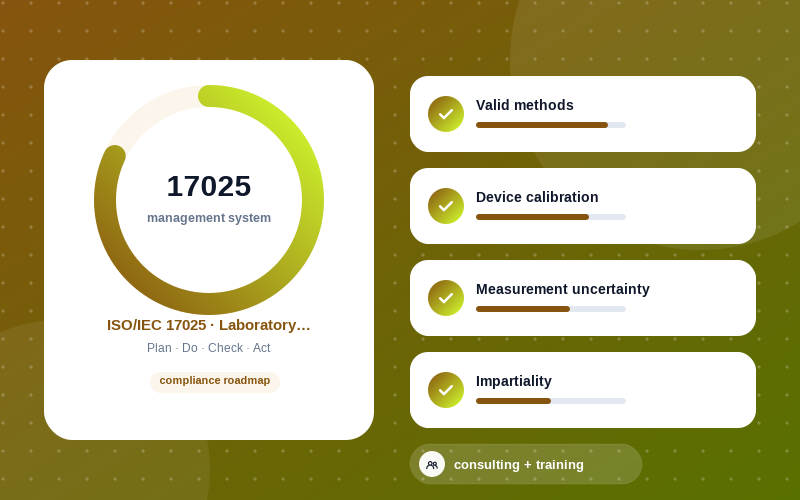
ISO/IEC 17025:2017

ISO/IEC 17025 consulting

General requirements for the competence of testing and calibration laboratories

ISO/IEC 17025 consulting

What is ISO/IEC 17025?

Sets out the requirements for the technical competence, impartiality and consistent operation of testing and calibration laboratories.

Purpose and scope

Establishing a laboratory system that can produce valid and traceable measurement results.

Who is it suitable for?

Testing and calibration laboratories.

Required processes

  • Measurement traceability
  • Measurement uncertainty
  • Method verification and validation
  • Ensuring the validity of results

Implementation stages

  1. Initial meeting and scope definition
  2. Current state (gap) analysis
  3. Implementation plan and role assignment
  4. Developing policies, processes and documents
  5. Implementation and employee training
  6. Internal audit and management review
  7. Support in preparing for the certification body's audit

Scope of consulting

  • Current state and gap analysis
  • System design and document preparation support
  • Employee awareness and implementation training
  • Internal audit support and corrective action tracking
  • Preparation for the certification audit (the certification decision does not rest with BDHA)

Training and implementation support

Awareness, implementation and internal auditor training for ISO/IEC 17025, together with implementation support throughout the process, is provided. Training and is not a consulting, certification or accreditation activity.

ISO/IEC 17025 consulting helps testing and calibration laboratories meet the requirements for impartiality, confidentiality, metrological traceability and the production of valid results. Deliverables include method validation files, uncertainty budgets and quality system records ready for accreditation.

Impartiality and management requirements

The laboratory's legal status, organisational structure and customer relationships are examined, situations that could threaten impartiality are identified, and a risk assessment is carried out. Confidentiality commitments, complaint and appeal processes and the work acceptance procedure are set up, and review of requests, tenders and contracts is supported by traceable records.

Measurement uncertainty and metrological traceability

For each test or calibration method, the sources contributing to measurement uncertainty are identified, the uncertainty budget is calculated and tied to reporting rules. The traceability of reference standards and measuring instruments to the international system of units is shown through calibration certificates, and intermediate check plans and calibration intervals are set on the basis of data.

Assurance of valid results and accreditation readiness

The validity of results is monitored through proficiency testing, interlaboratory comparisons, control samples and repeat measurements. BDHA does not grant accreditation or certification; these are carried out by authorised bodies. BDHA prepares the application file, scope table and internal audit records, rehearses before the assessment and accompanies the laboratory in closing findings.

What is included?

  • Management system option: it is decided whether the laboratory builds its own system or one aligned with ISO 9001, and the document and record structure is created accordingly.
  • Personnel and competence: job descriptions, an authorisation matrix, and training and observation records demonstrate the competence of every person performing tests.
  • Facilities and environmental conditions: monitoring, recording and impact assessment of conditions such as temperature, humidity and vibration are planned.
  • Method selection and validation: the suitability of standard, non-standard and laboratory-developed methods is verified or validated, and records are filed.
  • Reporting and decision rules: the content of test and calibration reports, decision rules for statements of conformity and data security are defined.

How we work

  1. Discovery

    Initial assessment: the laboratory's scope, existing methods, instrument fleet and record keeping are reviewed, and a gap report is presented after determining the parameters to be included in the accreditation scope.

  2. Planning

    Planning: responsibilities are assigned, and the order of validation and uncertainty studies, the instrument calibration schedule and training needs are determined to build a project timetable that fits the laboratory's workload.

  3. Implementation

    Implementation: procedures are written, methods are validated, uncertainty budgets are calculated, environmental monitoring and sample handling are put into practice and personnel authorisation observations are carried out.

  4. Support

    Assessment preparation: the internal audit, management review and evaluation of proficiency test results are carried out, and support is provided for closing findings during and after the accreditation assessment.

What you gain

It is documented by which method, with what uncertainty and through which traceability chain results are produced, so customers can rely on reports with more confidence.

The laboratory is prepared, together with impartiality risk and competence records, for an assurance level that national and international buyers can accept.

Instrument, calibration and method records are kept in a single order, so the time spent finding evidence during audits is reduced and internal audits run more efficiently.

Who is it for?

Suitable for calibration and testing laboratories, quality control and measurement laboratories of manufacturing companies, environmental, food, materials and electrical-electronic test centres, and R&D laboratories. Laboratory managers, technical managers and quality officers, as well as businesses for which accreditation is required by customers or regulation, are the target audience.

Frequently Asked Questions

Is ISO/IEC 17025 certified or is a laboratory accredited?

For this standard, laboratories are generally accredited rather than certified. Accreditation means that a national accreditation body assesses the laboratory's technical competence for tests or calibrations within a defined scope. BDHA does not grant accreditation; it prepares the organisation for the application and assessment process, organises files and supports the closure of nonconformities.

Is it mandatory to calculate measurement uncertainty?

The standard requires laboratories to identify the contributions to measurement uncertainty and to evaluate them where appropriate. For calibration laboratories this is essential; in testing laboratories the approach may vary with the nature of the method. In practice, the uncertainty budget allows results to be interpreted together with decision rules and statements of conformity to be given with confidence.

Related services and resources

The edition and validity status must be verified against the official ISO/IEC catalogue and the national standards body before publication.

Quote & demo

Let's evaluate your project together.

Let's start with a short call about QISO demo, ISO consulting, Artificial intelligence feasibility or your custom software needs.

  • QISO demo
  • ISO consulting
  • Artificial intelligence
  • Custom Software