

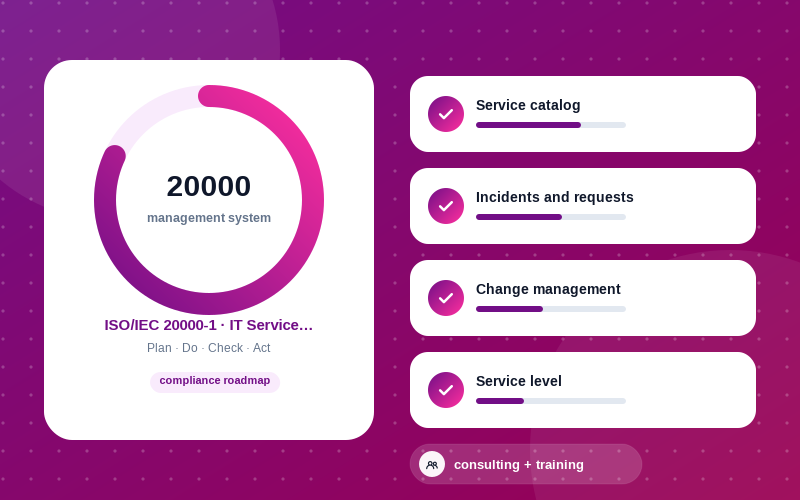
ISO/IEC 20000-1:2018

ISO/IEC 20000-1 consulting

Information technology — Service management — Service management system requirements

ISO/IEC 20000-1 consulting

What is ISO/IEC 20000-1?

Defines the service management system requirements for planning, delivering and improving IT services.

Purpose and scope

Delivering IT services in line with customer requirements in a measurable, continually improved way.

Who is it suitable for?

Organizations providing internal or external IT services, and managed service providers.

Required processes

  • Service catalog and SLA management
  • Incident and request management
  • Change and release management
  • Capacity and continuity management

Implementation stages

  1. Initial meeting and scope definition
  2. Current state (gap) analysis
  3. Implementation plan and role assignment
  4. Developing policies, processes and documents
  5. Implementation and employee training
  6. Internal audit and management review
  7. Support in preparing for the certification body's audit

Scope of consulting

  • Current state and gap analysis
  • System design and document preparation support
  • Employee awareness and implementation training
  • Internal audit support and corrective action tracking
  • Preparation for the certification audit (the certification decision does not rest with BDHA)

Training and implementation support

Awareness, implementation and internal auditor training for ISO/IEC 20000-1, together with implementation support throughout the process, is provided. Training and is not a consulting, certification or accreditation activity.

ISO/IEC 20000-1 consulting sets up an IT service management system: the service catalogue, SLAs, and incident, problem and change management processes are defined and made ready for certification audit.

Service catalogue and service levels

The work starts by describing the services the IT unit provides in the customer's language. A service catalogue is prepared, and each service gets an owner, operating hours, support channels and measurable service levels. Service level agreements are handled together with underpinning contracts and internal operational arrangements, so the gap between expectation and actual performance can be tracked.

Incident, problem and change processes

Starting from service desk records, rules for incident classification, prioritization and escalation are defined. For recurring incidents, problem management carries out root cause analysis and maintains a known error record. In change management, the request, risk assessment, approval and back-out plan are handled together, and release and deployment management keep changes to the production environment under control.

Certification and the limits of our role

BDHA does not issue certificates; certification is carried out by authorized, accredited certification bodies. BDHA provides consulting and preparation: process design, preparing documents and records, internal audit and management review fall within this scope. Teams are brought to the maturity needed to evidence the day-to-day operation of the system with records.

What is included?

  • Service management system scope: The services, customers, locations and supplier relationships covered by the system are defined through context analysis.
  • Service catalogue and SLA management: Service definitions, service levels, reporting periods and customer satisfaction measurement are established.
  • Incident and service request management: The service desk flow, priority matrix, escalation rules and resolution times are defined, and records are made measurable.
  • Change, release and configuration management: A change board, approval flow, configuration records and release planning are organized.
  • Service continuity, information security and supplier management: Capacity, continuity and security requirements and subcontractor performance are monitored.

How we work

  1. Discovery

    Current IT services, service desk practices, tools and contracts are reviewed; a gap analysis against the standard is carried out and scope, process owners and the project timeline are clarified.

  2. Planning

    The service catalogue, SLA templates and process flows are designed; roles, responsibilities and record formats are defined for incident, problem, change and configuration management.

  3. Implementation

    Processes are adapted to the ITSM tool or existing support system, teams are trained, and real records are collected during a pilot period; measurements and reports are put into operation.

  4. Support

    The internal audit and management review are held and findings closed; service reports and records are reviewed together before the certification audit, and support is provided during the audit.

What you gain

IT services are offered through a catalogue business units can understand, and service levels are measured and reported regularly.

Root causes of recurring failures are addressed, disruptions caused by changes decrease, and the support team manages priorities in a clear order.

You gain a system that can demonstrate the maturity of your IT service management in customer contracts and tenders through documented processes and records.

Who is it for?

Suited to software and systems integrators, managed service providers, data centers, contact centers and internal IT departments that deliver IT services to customers. It is designed for IT managers and service owners who want to manage service levels through records and measurement, reduce disruptions and show their maturity with documents in tenders.

Frequently Asked Questions

What is the difference between ISO/IEC 20000-1 and ITIL?

ITIL is a best-practice library for service management and does not provide a certifiable set of requirements. ISO/IEC 20000-1 is a management system standard with auditable requirements. The two complement each other: ITIL practices guide process design, while the standard provides the basis for demonstrating the system.

Is the standard too heavy for a small IT team?

The standard scales with the size of the organization; a separate unit for each process is not needed. In small teams one person can hold several roles, and records can be kept in the existing ticketing system. What matters is that processes are defined, records are consistent and responsibilities are clear; in consulting the workload is simplified accordingly.

Related services and resources

The edition and validity status must be verified against the official ISO/IEC catalogue and the national standards body before publication.

Quote & demo

Let's evaluate your project together.

Let's start with a short call about QISO demo, ISO consulting, Artificial intelligence feasibility or your custom software needs.

  • QISO demo
  • ISO consulting
  • Artificial intelligence
  • Custom Software