

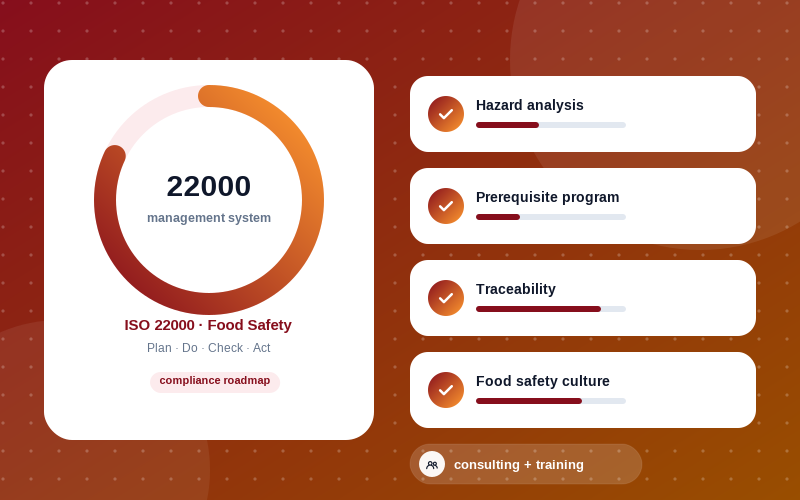
ISO 22000:2018

ISO 22000 consulting

Food safety management systems — Requirements for any organization in the food chain

ISO 22000 consulting

What is ISO 22000?

A standard that combines HACCP principles with a management system to deliver safe products in the food chain.

Purpose and scope

Keeping food safety hazards under control and ensuring trust across the food chain.

Who is it suitable for?

Food manufacturers and organizations providing packaging, storage, transport and food service.

Required processes

  • Hazard analysis and critical control points
  • Prerequisite programs
  • Traceability and recall
  • Verification activities

Implementation stages

  1. Initial meeting and scope definition
  2. Current state (gap) analysis
  3. Implementation plan and role assignment
  4. Developing policies, processes and documents
  5. Implementation and employee training
  6. Internal audit and management review
  7. Support in preparing for the certification body's audit

Scope of consulting

  • Current state and gap analysis
  • System design and document preparation support
  • Employee awareness and implementation training
  • Internal audit support and corrective action tracking
  • Preparation for the certification audit (the certification decision does not rest with BDHA)

Training and implementation support

Awareness, implementation and internal auditor training for ISO 22000, together with implementation support throughout the process, is provided. Training and is not a consulting, certification or accreditation activity.

ISO 22000 consulting brings HACCP principles, prerequisite programmes and traceability together under a single food safety management system. Deliverables include the hazard analysis, the HACCP plan and records that are ready for a certification audit.

Hazard analysis and HACCP plan

Production flow diagrams are verified on site, and biological, chemical and physical hazards are assessed for every step. For the significant hazards, critical control points, critical limits, monitoring methods and corrective actions are defined. As a result, the HACCP plan does not stay on paper but becomes a control tool that line staff can apply every day.

Prerequisite programmes and traceability

Prerequisite programmes such as cleaning and disinfection, pest control, personnel hygiene, allergen management and supplier approval are designed around the organisation's own facility. Batch-level traceability and product recall scenarios are rehearsed so that the system's response speed in a real incident is tested in advance.

Managing the certification process

BDHA does not issue certificates; certification is carried out by authorised and accredited bodies. BDHA supports the organisation in choosing a certification body and preparing for the audit: it prepares the internal audit, the management review and the closure of findings, rehearses the audit day with the team and follows up corrective actions afterwards.

What is included?

  • Food safety policy: framework documents are prepared that define top management commitment, objectives and the roles and authorities of the food safety team.
  • Hazard analysis: hazards are assessed by raw material, process and product, and risk levels and control measures are recorded.
  • Operational prerequisite programmes: monitoring criteria and responsibilities are defined for control measures that are not critical points but still matter.
  • Verification and validation: the effectiveness of control measures is confirmed through analysis results, calibration records and internal audits.
  • Emergencies and recall: the communication chain, product withdrawal and record-keeping procedures to be used in food safety incidents are established.

How we work

  1. Discovery

    Current state assessment: a site walk-through and review of production flows are carried out, and a gap analysis report compares existing food safety practices with the standard's requirements.

  2. Planning

    Planning: the food safety team is formed, product groups and flow diagrams are clarified, and a scheduled implementation plan with a responsibility matrix is created.

  3. Implementation

    Implementation: the hazard analysis, HACCP plan, procedures and record forms are put into use, and staff are trained in hygiene and in monitoring critical control points.

  4. Support

    Audit preparation and support: the internal audit and management review are completed, nonconformities are closed, and consulting support continues during and after the certification audit.

What you gain

Food safety hazards are identified and controlled systematically, and it is clear which parameter is monitored at which point on the production line.

A system based on verifiable records is established that can answer the food safety expectations of customers, retail chains and regulatory authorities.

Thanks to traceability, affected batches can be identified quickly in recalls and incidents, and the relevant parties are informed in time.

Who is it for?

Suitable for food manufacturers, packing and storage facilities, catering and mass-catering companies, organisations providing food packaging or logistics services, and businesses supplying retail chains. Alongside quality, production and product development managers, executives preparing for customer audits or regulatory requirements also benefit from this work.

Frequently Asked Questions

What is the difference between ISO 22000 and HACCP?

HACCP is a method focused on hazard analysis and critical control points. ISO 22000 combines these principles with management system elements such as policy, objectives, resource management, communication, internal audit and continual improvement. HACCP is therefore an important part of an ISO 22000 system, but it does not cover the whole standard on its own.

Can a small producer implement ISO 22000?

Yes. The standard can be applied by organisations of any size in the food chain. In small businesses the system is kept lean: the number of documents stays limited and existing hygiene practices are used as a starting point. What matters is that hazards are analysed correctly and that practice can be proven with records. The scope is clarified together with the certification body.

Related services and resources

The edition and validity status must be verified against the official ISO/IEC catalogue and the national standards body before publication.

Quote & demo

Let's evaluate your project together.

Let's start with a short call about QISO demo, ISO consulting, Artificial intelligence feasibility or your custom software needs.

  • QISO demo
  • ISO consulting
  • Artificial intelligence
  • Custom Software