

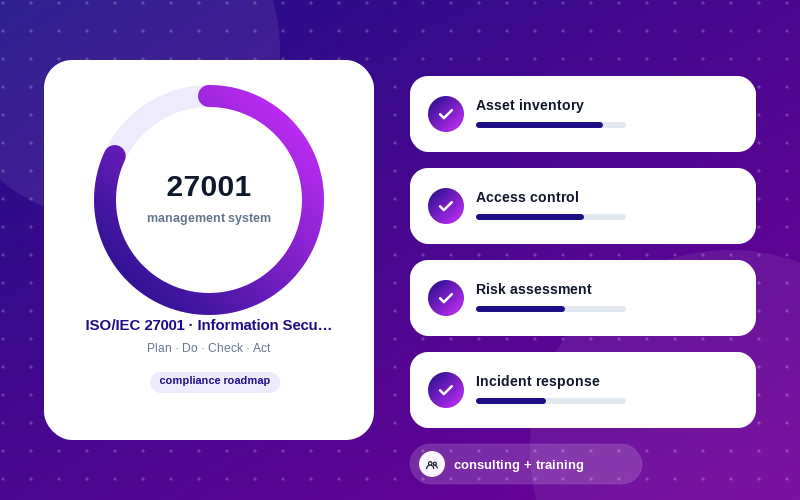
ISO/IEC 27001:2022

ISO/IEC 27001 consulting

Information security, cybersecurity and privacy protection — Information security management systems — Requirements

ISO/IEC 27001 consulting

What is ISO/IEC 27001?

A standard that defines the requirements of an information security management system to protect the confidentiality, integrity and availability of information assets.

Purpose and scope

Managing Information security risks and applying control measures systematically.

Who is it suitable for?

Any organization with customer data, intellectual property or critical systems, especially software and service providers.

Required processes

  • Information asset inventory
  • Risk assessment and treatment
  • Statement of Applicability
  • Incident management
  • Access control

Implementation stages

  1. Initial meeting and scope definition
  2. Current state (gap) analysis
  3. Implementation plan and role assignment
  4. Developing policies, processes and documents
  5. Implementation and employee training
  6. Internal audit and management review
  7. Support in preparing for the certification body's audit

Scope of consulting

  • Current state and gap analysis
  • System design and document preparation support
  • Employee awareness and implementation training
  • Internal audit support and corrective action tracking
  • Preparation for the certification audit (the certification decision does not rest with BDHA)

Training and implementation support

Awareness, implementation and internal auditor training for ISO/IEC 27001, together with implementation support throughout the process, is provided. Training and is not a consulting, certification or accreditation activity.

With ISO/IEC 27001 consulting, an information security management system (ISMS) is built from risk analysis to the Statement of Applicability, policies and procedures to internal audit, and delivered as a working system ready for certification audit.

Information assets and the risk approach

The work starts by defining the scope and identifying information assets: data, applications, infrastructure, suppliers and people are inventoried. Threats and vulnerabilities are assessed for each asset, risk acceptance criteria are defined and a risk treatment plan is prepared. Security decisions therefore rest on a traceable risk analysis aligned with business objectives rather than on intuition.

Control selection and the Statement of Applicability

Based on the risk treatment results, Annex A controls are selected; implemented and excluded controls are documented with their justification in the Statement of Applicability. Policy, procedure and technical requirements in areas such as access management, cryptography, logging, supplier relationships, incident management and physical security are tailored to how the organization actually operates.

Certification and the limits of our role

BDHA does not issue certificates; certification is carried out by authorized, accredited certification bodies. BDHA provides consulting and preparation: documentation, internal audit, management review and a gap analysis ahead of the stage 1 audit are part of the scope. Choosing the certification body and setting the audit schedule remain the organization's decisions.

What is included?

  • ISMS scope and boundaries: The units, locations, processes and interfaces covered by the information security management system are clarified through context analysis.
  • Risk assessment: Likelihood and impact are scored by matching assets, threats and vulnerabilities, and acceptable risk levels are agreed together with management.
  • Policies and procedures: An information security policy and topic-specific procedures such as access, backup, change management and incident response are prepared.
  • Awareness and competence: Security awareness training for staff is planned, with recorded sessions on topics such as phishing and clean desk practices.
  • Internal audit and review: ISMS internal audits are conducted, corrective actions for nonconformities are tracked and the management review is prepared.

How we work

  1. Discovery

    Existing security practices, contractual and legal obligations, the asset inventory and stakeholder expectations are reviewed; the gap analysis then helps define scope, objectives and the project timeline together with management.

  2. Planning

    A risk methodology is established, an asset-based risk assessment is carried out, and the risk treatment plan and a draft Statement of Applicability are produced; responsibilities and information security roles are assigned.

  3. Implementation

    The selected controls are implemented: policies are published, procedures and record forms are put into use, technical controls are verified together with the IT team and staff receive awareness training.

  4. Support

    The internal audit and management review are completed and findings closed; support is given in preparing the organization and answering questions during the certification body's stage 1 and stage 2 audits.

What you gain

Confidentiality, integrity and availability risks to information assets become visible, and security investments are prioritized according to real risks.

Your organization can demonstrate its information security approach in customer, tender and regulatory requests, backed by documents and records.

Incident management, access rights and supplier security are monitored in a regular cycle, and measurable objectives support continual improvement.

Who is it for?

Suited to organizations that handle customer data, trade secrets or critical infrastructure: software and IT service providers, data centers, financial and healthcare institutions, public-sector suppliers and e-commerce companies. It is designed for management and IT teams that want information security to be systematic, documented and auditable rather than dependent on individuals.

Frequently Asked Questions

Which risk method should be used for ISO/IEC 27001?

The standard does not prescribe a particular method; it only requires that the method produces consistent, repeatable and comparable results. In consulting, a simple asset-based or scenario-based method suited to the organization's size and asset structure is chosen, acceptance criteria are written down together with management and reviewed every year.

Can we exclude a control in the Statement of Applicability?

Yes, but the reason for exclusion must be risk-based and written down. For example, if the organization does not develop software, secure development controls may be excluded. The certification body questions these justifications during the audit, so each exclusion decision is tied to a risk assessment that can be evidenced.

Related services and resources

The edition and validity status must be verified against the official ISO/IEC catalogue and the national standards body before publication.

Quote & demo

Let's evaluate your project together.

Let's start with a short call about QISO demo, ISO consulting, Artificial intelligence feasibility or your custom software needs.

  • QISO demo
  • ISO consulting
  • Artificial intelligence
  • Custom Software