

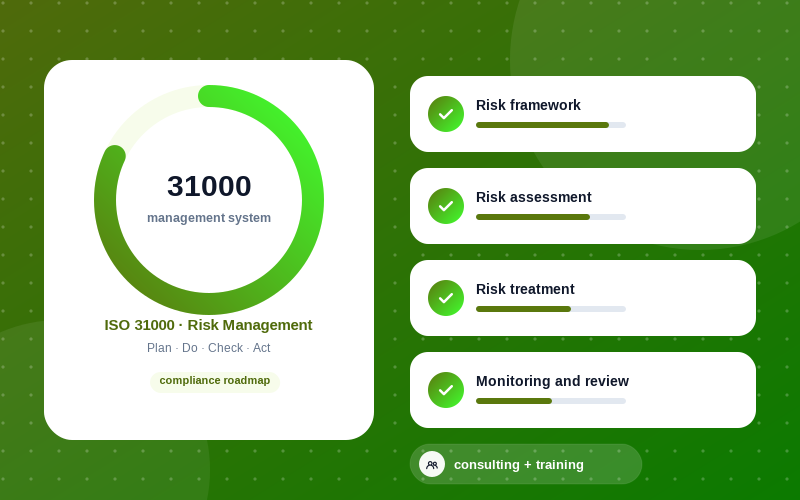
ISO 31000:2018

ISO 31000 consulting

Risk management — Guidelines

ISO 31000 consulting

What is ISO 31000?

A standard applicable to any type of organization, providing risk management principles, a framework and process guidance.

Purpose and scope

Systematically managing the effect of uncertainty on objectives.

Who is it suitable for?

Any organization looking to structure Company risk management.

Required processes

  • Risk identification
  • Risk analysis and assessment
  • Risk treatment
  • Monitoring and reporting

Implementation stages

  1. Initial meeting and scope definition
  2. Current state (gap) analysis
  3. Implementation plan and role assignment
  4. Developing policies, processes and documents
  5. Implementation and employee training
  6. Internal audit and management review
  7. Support in preparing for the certification body's audit

Scope of consulting

  • Current state and gap analysis
  • System design and document preparation support
  • Employee awareness and implementation training
  • Internal audit support and corrective action tracking
  • Preparation for the certification audit (the certification decision does not rest with BDHA)

Training and implementation support

Awareness, implementation and internal auditor training for ISO 31000, together with implementation support throughout the process, is provided. Training and is not a consulting, certification or accreditation activity.

ISO 31000 consulting helps an organisation identify, evaluate and treat its risks within a coherent set of principles, framework and process. Deliverables include a risk management policy, a risk register, evaluation criteria and monitoring reports.

Context, risk appetite and criteria

Risk management starts with understanding the organisation's internal and external context: objectives, stakeholders, legislation, market conditions and operational dependencies are mapped. Through work with top management, risk appetite and tolerance are set, and scales for likelihood, impact and acceptability are defined to suit the organisation's size and sector.

Risk assessment and treatment

Risks are identified through brainstorming, process analysis, scenario work and historical incident data, then analysed and rated together with their owners. For prioritised risks, options of avoiding, reducing, sharing or accepting are evaluated, and each treatment plan is entered in the register with an owner, a deadline and an expected residual risk, then reviewed at regular intervals.

Guidance nature and relationship with other standards

ISO 31000 is guidance rather than a certifiable requirements standard, and BDHA does not issue certificates either; authorised and accredited bodies perform certification. The guiding principles feed the risk-based requirements of standards such as ISO 9001, ISO/IEC 27001, ISO 22301 and ISO 45001, and BDHA helps unify this shared framework into a single risk language and record structure.

What is included?

  • Risk management policy and governance: top management commitment, risk ownership, reporting lines and decision authorities are defined.
  • Risk criteria and scales: likelihood, impact, the risk matrix, and appetite and tolerance levels are set specifically for the organisation.
  • Risk identification workshops: risk lists are built through workshops for processes, projects, the supply chain and information assets.
  • Risk register and treatment plans: each risk's owner, controls, residual risk and treatment actions are kept in a traceable structure.
  • Monitoring and reporting: key risk indicators, periodic risk reports and summaries that feed the management review are prepared.

How we work

  1. Discovery

    Initial assessment: existing risk practices, objectives and decision mechanisms are reviewed, and interviews with management show how risk management currently works in the organisation.

  2. Planning

    Framework design: the policy, roles, criteria and risk methodology are documented, integrated so that they do not conflict with the organisation's existing management systems, and submitted for management approval.

  3. Implementation

    Implementation: risk workshops are held with the various units, the register is populated, risks are rated, and treatment plans are set together with their owners and presented to management.

  4. Support

    Monitoring and development: risk indicators and treatment status are monitored periodically, the register is updated as the context changes, and the maturity level is raised through annual reviews.

What you gain

Management takes strategic and operational decisions in a shared risk language, and which risk to accept and which to treat rests on explicit criteria.

Risks come together in a single register, and risk work in systems such as ISO 9001, information security, business continuity and occupational health and safety feeds each other without duplication.

Preparedness for unexpected events improves, and early warning indicators bring problems to the management agenda before they cause harm.

Who is it for?

Suitable for top management, risk and compliance officers, quality and internal audit teams, and project and operations managers. Mid-sized businesses setting up risk management for the first time, organisations wanting to combine several management systems in a common risk structure, and public bodies benefit directly from this work.

Frequently Asked Questions

Can ISO 31000 be certified?

ISO 31000 is a guidance document without requirements, so it is not designed for certification. Organisations use the standard to establish and improve their own risk management frameworks, and the value of the work lies less in a certificate than in risks genuinely informing decision making. BDHA sets up the framework consistently with the organisation's existing systems and in a way that can be shown at audit.

Is dedicated software essential for risk management?

No, the process can also be run with a spreadsheet. However, once the number of risks, units and treatment plans grows, version control, reminders, authorisation and reporting become difficult. At that stage, keeping the register inside a quality management system such as QISO makes it easier to link risks with action, audit and KPI records.

Related services and resources

This is a guidance standard, not a certification standard. Its version and validity status must be verified against the official ISO/IEC catalogue and the national standards body before publication.

Quote & demo

Let's evaluate your project together.

Let's start with a short call about QISO demo, ISO consulting, Artificial intelligence feasibility or your custom software needs.

  • QISO demo
  • ISO consulting
  • Artificial intelligence
  • Custom Software