

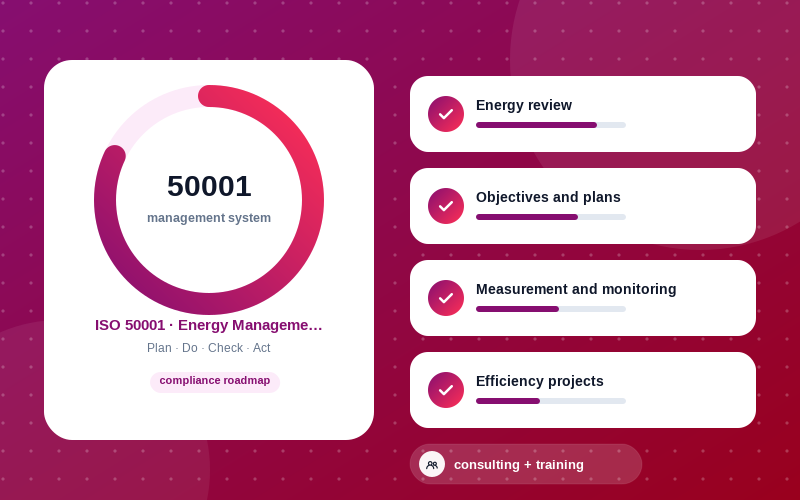
ISO 50001:2018

ISO 50001 consulting

Energy management systems — Requirements with guidance for use

ISO 50001 consulting

What is ISO 50001?

Provides an energy management system framework that helps organizations systematically monitor and improve their energy performance.

Purpose and scope

Measuring Energy consumption, improving energy performance and managing costs.

Who is it suitable for?

Energy-intensive production facilities, commercial buildings and organizations providing energy services.

Required processes

  • Energy review
  • Energy performance indicators
  • Establishing the baseline
  • Monitoring of significant energy uses

Implementation stages

  1. Initial meeting and scope definition
  2. Current state (gap) analysis
  3. Implementation plan and role assignment
  4. Developing policies, processes and documents
  5. Implementation and employee training
  6. Internal audit and management review
  7. Support in preparing for the certification body's audit

Scope of consulting

  • Current state and gap analysis
  • System design and document preparation support
  • Employee awareness and implementation training
  • Internal audit support and corrective action tracking
  • Preparation for the certification audit (the certification decision does not rest with BDHA)

Training and implementation support

Awareness, implementation and internal auditor training for ISO 50001, together with implementation support throughout the process, is provided. Training and is not a consulting, certification or accreditation activity.

ISO 50001 consulting establishes an energy management system: through the energy review, significant energy uses, energy performance indicators and action plans, energy performance is monitored and improved in a systematic way.

Energy review and metering

The work starts with collecting consumption data for energy sources such as electricity, natural gas, fuel, steam and compressed air across the facility. The energy review identifies significant energy uses and shows which equipment, shift or process drives consumption. Missing measurement points are detected and the need for sub-meters or data collection is planned.

Performance indicators and baselines

Energy performance indicators are normalized against relevant variables such as production volume, weather conditions or operating hours, and an energy baseline is established. This makes it possible to tell whether a change in consumption comes from real improvement or from a difference in output. Objectives and action plans are linked to these indicators, and investment and operational measures are prioritized.

Certification and the limits of our role

BDHA does not issue certificates; certification is carried out by authorized, accredited certification bodies. BDHA provides consulting and preparation: drafting the policy, documents and records, internal audit and management review fall within this scope. Because energy savings depend on the facility and operating conditions, no specific savings rate is promised.

What is included?

  • Scope and energy policy: The facilities, processes and energy types covered are defined, and an energy policy expressing top management's commitment is written.
  • Energy review: Consumption data is analyzed and significant energy uses and improvement opportunities are listed in detail.
  • Indicators and baseline: Energy performance indicators are defined, normalized against relevant variables and given a monitoring frequency.
  • Objectives and action plans: Measurable energy objectives are set, and action plans specifying responsibility, resources, timing and verification method are prepared.
  • Purchasing, design and operational control: Criteria are set for equipment purchases, design changes and maintenance practices that affect energy use.

How we work

  1. Discovery

    Bills, meter data, facility layouts and existing efficiency studies are collected; short site walks help visualize energy flows, and scope and project team are agreed with management.

  2. Planning

    The energy review is completed, significant energy uses, performance indicators and baselines are established, and legal and other requirements are listed.

  3. Implementation

    Objectives, action plans, operational controls and a monitoring routine are set up; awareness and competence activities are carried out for operators and maintenance teams.

  4. Support

    Energy performance monitoring, internal audit and management review are completed, nonconformities are closed, and records are reviewed together ahead of the certification audit.

What you gain

It becomes visible with data where, when and in which process energy is used, and savings opportunities are identified from measurement rather than intuition.

Energy objectives, investment decisions and maintenance practices are tied to a common set of indicators, and progress is reported to management regularly.

You gain a documented energy management system and certification-ready records that support regulatory compliance, carbon footprint work and customer requests.

Who is it for?

Suited to organizations where energy cost is a noticeable share of production cost: manufacturing and industrial plants, textile, food, plastics and metalworking companies, industrial zones, hotels, hospitals and large office buildings. It is designed for facility, maintenance and environmental managers who want to manage energy consumption through measurement and be prepared for regulatory and customer expectations.

Frequently Asked Questions

What facility size is suitable for ISO 50001?

The standard is independent of size; a single building or a multi-site group, any organization that uses energy, can define a scope. In small facilities the metering and data collection are kept simple. What matters is that energy use can be measured and that management is ready to allocate resources for improvement.

Can ISO 50001 be implemented together with ISO 14001?

Yes. Since both standards follow the same management system structure, common elements such as policy, document control, internal audit and management review can be combined. The differing parts are the energy-specific review and indicators and the environmental aspects; these are handled separately, which reduces duplicated workload.

Related services and resources

The edition and validity status must be verified against the official ISO/IEC catalogue and the national standards body before publication.

Quote & demo

Let's evaluate your project together.

Let's start with a short call about QISO demo, ISO consulting, Artificial intelligence feasibility or your custom software needs.

  • QISO demo
  • ISO consulting
  • Artificial intelligence
  • Custom Software