

Custom Software & Enterprise Technology

Enterprise Web Applications | Custom Software & Enterprise Technology

We develop secure, scalable web applications for your internal operations and business partners.

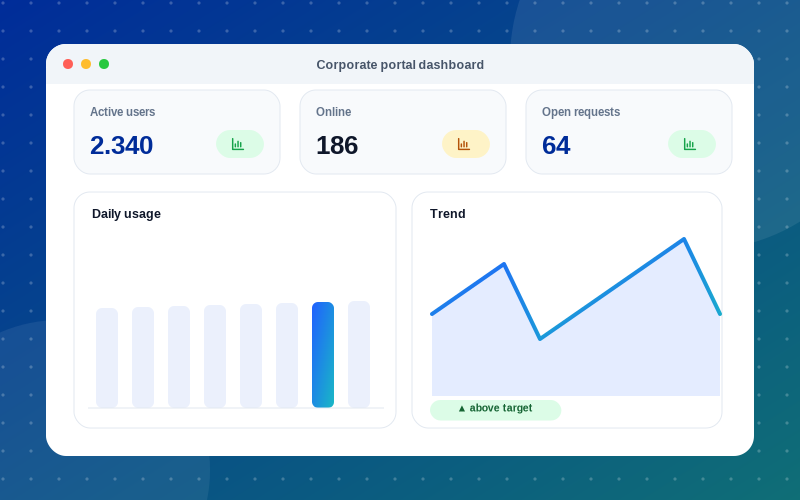
Enterprise Web Applications – image 1
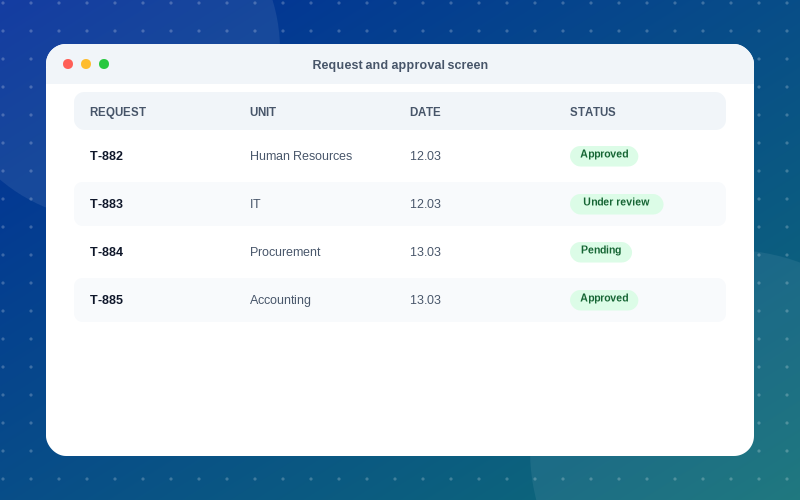
Enterprise Web Applications – image 2

We develop ASP.NET Core based web applications with role-based authorisation and automated testing for your internal operations and business partners. Deliverables include source code, deployment scripts, technical documentation and an operations handover.

Layered architecture and a maintainable codebase

Applications are written on ASP.NET Core and separated into presentation, business logic and data access layers. Dependencies are injected, business rules are protected by unit tests and database changes are managed through versioned migrations. This structure lets a new developer understand the code quickly and keeps the cost of adding features under control.

Enterprise authentication and authorisation

Users sign in with single sign-on through Active Directory, LDAP or an OpenID Connect based identity provider, so no separate password management is needed. Permissions are defined at role, department and record level. Critical operations are written to an audit trail, so who changed what and when can be reported. Passwords are not stored, sensitive fields are encrypted and session lifetimes follow your policy.

Deployment, monitoring and handover

The application is deployed to IIS or a container environment through an automated pipeline, across separate development, test and production environments. Error logs and performance metrics are collected centrally, and notifications go to the responsible person when set thresholds are exceeded. At delivery, the architecture diagram, installation guide, backup scenario and incident response steps are handed over in writing.

What is included?

  • Architecture and data model: layer separation, data access with Entity Framework Core, versioned database migrations and performance-oriented index design.
  • Identity and permissions: single sign-on with Active Directory or OpenID Connect, role and department based permissions, audit trail logging.
  • Interface and usability: responsive design, filterable lists, Excel and PDF outputs and forms that follow accessibility principles.
  • Quality assurance: unit and integration tests, code review, static analysis and acceptance test scenarios for critical flows.
  • Deployment and operations: automated release pipeline, IIS or container setup, logging and monitoring configuration and a backup plan.

How we work

  1. Discovery

    We examine the target users, workflows and existing systems, and put security, performance and accessibility requirements in writing. The outcome is a prioritised backlog and a high-level architecture proposal.

  2. Planning

    We prepare screen prototypes and the data model and produce a threat model. The permission matrix, integration points and test strategy are reviewed with user representatives and the sprint plan is finalised.

  3. Implementation

    Development proceeds in two to three week sprints, with a working increment demonstrated at the end of each. Code review and automated tests run on every change, and security vulnerabilities are monitored through dependency scanning.

  4. Support

    After acceptance testing we take the application live, configure monitoring and backups, and train your operations team in a handover. Maintenance and enhancement requests then proceed under a contracted support arrangement.

What you gain

An application with a single secure sign-in and role-based permissions, with user management handled through your existing directory service.

A codebase protected by automated tests lets changes be made with less risk, keeping technical debt and maintenance cost under control.

Source code, documentation and deployment scripts are handed to you, so the application does not remain dependent on a single supplier.

Who is it for?

Suitable for mid-sized and large organisations that need a critical web application such as a dealer, supplier or customer portal, an internal request and approval system or a reporting interface, that find off-the-shelf products do not fit their processes, or that want to renew an old application that is hard to maintain.

Frequently Asked Questions

Why do you choose ASP.NET Core, and can you migrate my legacy ASP.NET application?

ASP.NET Core is an actively supported, high-performance platform that runs on Windows and Linux and integrates well with enterprise identity and database tools. For legacy applications we first carry out an inventory and dependency analysis, then present a staged migration plan. Migrating every application may not be economical, and we state that clearly in the analysis.

Who owns the source code of the application?

Intellectual property and code delivery terms are set out explicitly in the contract. As a general practice, the source code of an application developed specifically for you is delivered and the rights of use rest with you according to the contract. Third-party open-source components come under their own licences, and a list of the components used with their licences is included in the documentation.

Related services and resources

Quote & demo

Let's evaluate your project together.

Let's start with a short call about QISO demo, ISO consulting, Artificial intelligence feasibility or your custom software needs.

  • QISO demo
  • ISO consulting
  • Artificial intelligence
  • Custom Software